
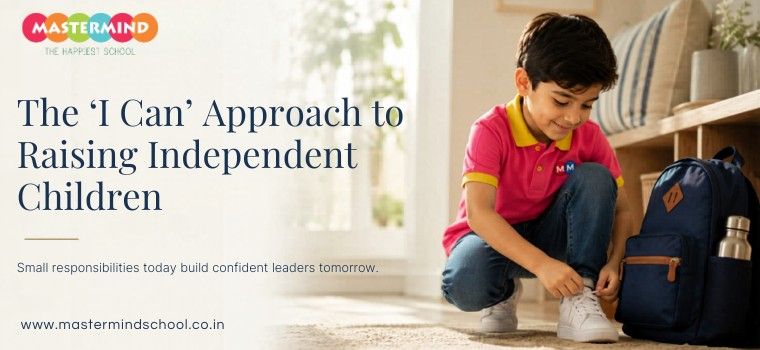
The I Can Approach to Raising Independent Children
Introduction
Modern parenting is full of love, care, protection, and expectations. Every parent wants their child to study well, speak confidently, behave responsibly, and face life with courage. But sometimes, parents unknowingly start doing too much for their children.
From packing the school bag to solving small problems, parents often step in quickly because they care deeply. But childhood is also the time when children must slowly learn to do things on their own.
This is where the “I Can” approach becomes very important. It helps children believe in their own abilities, try new things, learn from mistakes, and take small responsibilities.
For parents exploring the right school environment in Indore, this mindset is very important. Parents today want children to become independent, confident, expressive, and emotionally strong.
1. What Is the “I Can” Approach?
The “I Can” approach is a mindset of self-dependence. It encourages children to believe that they can do age-appropriate tasks, solve simple problems, and learn from mistakes.
When a child says, “I can pack my bag,” “I can wear my shoes,” or “I can try again,” the child is not only completing a task. The child is building inner confidence.
This approach does not mean pushing children beyond their capacity. It simply means giving them the right task at the right age and supporting them patiently.
2. Why Independence Matters
Independence is an important part of child development. It helps children build confidence, responsibility, decision-making ability, problem-solving skills, and emotional maturity.
Self-confidence: When children complete small tasks independently, they feel proud and become more willing to participate, speak, and try new activities.
Responsibility: When children keep their school bag ready or organize their study table, they learn discipline and ownership.
Decision making: Small choices like selecting a book or arranging study materials help children think independently.
Problem solving: Children who are encouraged to think learn to ask, “How can I do this?” instead of saying, “I cannot do this.”
Emotional growth: When children are allowed to try, make mistakes, and improve, they become less fearful and more confident.
3. Small Daily Tasks for Children
The best way to build independence is through simple daily tasks. Everyday life gives many opportunities to develop the “I Can” mindset.
Arrange the school bag: Children can learn to keep books, notebooks, diary, and pencil box in their bag with simple guidance.
Keep toys properly: After playtime, children should be encouraged to keep toys back in their place. This teaches discipline and responsibility.
Wear shoes and uniform: Children can slowly learn to wear shoes, socks, belt, or uniform parts by themselves. Patience is important in the beginning.
Fill the water bottle: A simple task like filling a water bottle makes a child feel responsible and prepared.
Organize the study table: Keeping books, pencils, colors, and notebooks properly builds focus and ownership.
These tasks may look small to adults, but for children, they are powerful confidence-building experiences.
4. Role of Parents
Parents play the most important role in building the “I Can” mindset. The way parents respond to a child’s effort, mistake, and struggle shapes the child’s confidence.
Encourage children: Simple words like “Try once more,” “You are improving,” and “I know you can do it” can make a big difference.
Avoid overhelping: When parents do everything for the child, the child may become dependent. Parents should allow children to try first.
Appreciate efforts: Appreciation should not be limited to results. Sincere effort should always be recognized.
Allow mistakes: Mistakes are natural. Instead of scolding immediately, parents can use mistakes as learning moments.
Build patience: Independence takes time. Children may not do tasks perfectly at first, but patient support helps them grow stronger.
5. Role of Schools
Schools also play a very important role in developing independent children. The school environment, teaching style, classroom culture, and teacher behavior all influence the child’s personality.
Activity-based learning: Activities, projects, experiments, storytelling, role play, and practical learning help children think and act independently.
Leadership opportunities: Small roles like line leader, group leader, class monitor, or activity helper build responsibility and confidence.
Communication skills: A school that encourages children to speak, ask questions, and share ideas helps them become expressive.
Practical responsibility: Classroom duties and participation in activities help children develop the habit of taking responsibility.
Positive environment: Children become confident when they feel safe, respected, and encouraged.
Parents searching for a school near Bicholi Bypass should observe whether the school focuses only on academics or also on confidence, participation, responsibility, and emotional growth.
6. How Parents and Schools Can Work Together
The “I Can” mindset becomes stronger when parents and schools work together. Both environments should support the same belief: “The child is capable.”
Parents can communicate with teachers about the child’s habits, confidence level, and areas where support is needed. Teachers can guide parents on how to encourage responsibility at home.
Children grow best when the adults around them believe in their potential.
Conclusion
The “I Can” approach is one of the most powerful ways to raise independent children. It helps children develop confidence, responsibility, decision-making ability, problem-solving skills, and emotional strength.
Independence does not come from big lectures. It comes from small daily habits like packing a school bag, arranging toys, wearing shoes, filling a water bottle, speaking in class, and learning from mistakes.
When parents and schools work together, children begin to believe:
“I can try.”
“I can learn.”
“I can improve.”
“I can grow.”
This belief becomes the foundation of lifelong confidence.
If you are a parent exploring schools in Indore, visiting nearby schools and understanding their teaching approach can help you choose the right environment for your child.
At Mastermind School, we welcome parents to experience a learning environment where children grow with confidence, happiness, responsibility, and the powerful belief of “I Can.”
Suggested Related Reading
Parents may also like to read about school activities that help children learn better, Happy Induction Program advantages, parent testimonials, screen time management for children, and school information and mandatory disclosure.
Author – Mr. Naveen Chowdhari
Naveen Chowdhari is a visionary educationist dedicated to redefining the academic landscape in Indore. As the Director of Mastermind School and Mastermind Abacus, he is a firm believer that premium, world-class education should be accessible to every aspiring student. Under his leadership, Mastermind School has become a benchmark for excellence—integrating advanced CBSE pedagogy, Robotics, and Smart-Class technology while maintaining a student-first approach to value. His mission is to empower the next generation of Indore with global skills and traditional roots.
Last Updated: 11 May 2026
Comments Section
Recent Posts
.jpeg)

08 Apr, 2026


Archives
- Talking to Kids about Sex and Puberty - Tips for Indian Parents
- Voices of Joy - Parental Testimonials
- Journey to Effective Parenting - Mastermind School Guide
- Mastermind Happy Induction program A Joyful Gateway to School Life
- First Day of Preschool: Overcoming Separation Anxiety
- Enroll Your Child with Ease - Joining the Happy Induction Program
- How to Support Your Childs Learning at Home
- Mastermind Schools - Happy Induction Program Advantages
- How To Prepare Your Child For Preschool
Speak Your Mind