
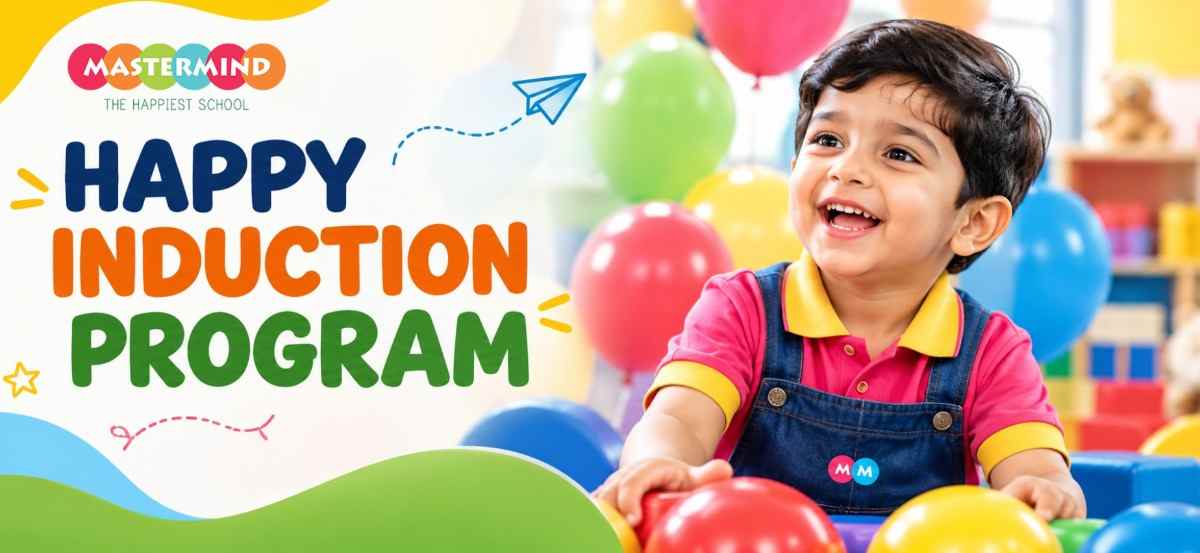
The Happy Induction Program is Mastermind School's settling-in programme for children who are joining school for the first time. Instead of meeting a new classroom, new teachers and a new routine all at once on the first day of the session, your child gets a slower, play-led start at our Pre-Primary Campus, so school already feels familiar when the full year begins.
At Mastermind, the new session opens on 1 April. For a two- or three-year-old, that date can mean a sudden jump from a whole day at home to a room full of unfamiliar faces. Most of the tears parents dread in the first week come from that jump, not from school itself.
This article explains how the programme works, who it suits, what a pre-primary day looks like, and what you can do at home to make the goodbye at the gate easier.
What Is the Happy Induction Program?
It is a short introductory spell of school that runs ahead of the regular pre-primary session. Children come to the Pre-Primary Campus, join a class, and spend their time on rhymes, stories, unstructured play and simple hands-on activities.
Nobody is trying to finish a syllabus in these weeks. The single aim is that your child begins to like coming to school and learns that you always come back at home time.
| Detail | What to know |
|---|---|
| Who it is for | Children starting school for the first time [CONFIRM: age band. The old blog said 2.6 to 3.6 years; the live site lists Play Group at 2+ and Nursery at 3+ as on 31 March] |
| When it runs | [CONFIRM: months. The old blog said January, February and March] |
| Where | Pre-Primary Campus, CA 6, Shreeji Valley, Bicholi Mardana, Indore |
| School hours | Pre-primary hours are 9:30 AM to 1:30 PM [CONFIRM: do induction children attend the full hours or a shorter day?] |
| Fees | See the school fees page or ask the office [CONFIRM: fee terms for the induction months] |
| What comes next | Play Group or Nursery in the new session from 1 April, depending on age |
What Makes the Happy Induction Program Special?
1. A calmer start, with less school anxiety
The first weeks of school are hard mainly because everything is new at the same moment: the building, the adults, the other children, the timetable and the separation from you. An induction period spreads that newness out.
Teachers use engaging activities, positive reinforcement and gradual separation to help each child adjust at a comfortable pace. By the time the regular session begins, the classroom, the teacher's face and the rhythm of the day are already known.
This does not mean there will be no tears. Some children cry for a few days and some need longer. What changes is that the hardest part happens in a low-pressure period, not in the middle of a busy new term. Our guide to separation anxiety on the first day of preschool covers this in more detail.
2. Time to see the school before you decide
Choosing a first school from a brochure and a short tour is difficult. An induction period lets you watch how your child responds over several weeks. Do they mention the teacher's name at home? Do they finish their tiffin? Do they walk in on their own?
You also get to see how the school communicates with you, through the school app, class groups, parent-teacher meetings and the class coordinator. [CONFIRM: the old blog said parents are not tied down for a full year and can decide after the induction months whether to continue. Is this still the policy?]
3. A place for children who just missed the age cut-off
Age for admission is counted as on 31 March, following CBSE guidelines. A child whose birthday falls a few weeks after that date can end up waiting almost a full year for a seat, which is a long time at this age.
[CONFIRM: the old blog said the programme covers the Play Group or Nursery curriculum for children who missed the cut-off, so they join the next session at the appropriate age. Is this still offered?] If your child is close to the cut-off, speak to the admissions office. The school would rather a child start comfortably than start early.
Why Do Young Children Cry at School Drop-Off?
Because they are attached to you, and that is a good thing. The American Academy of Pediatrics describes separation anxiety as entirely normal behaviour and a sign of a meaningful attachment, and notes that it is rare for it to continue daily beyond the preschool years.
So tears at the gate do not mean you have picked the wrong school, or that your child is not ready. Usually they mean your child has not yet learned that you come back. That lesson is learned through repetition: the same drop-off, the same goodbye and the same pick-up, day after day.
It also helps to remember where these years sit in a child's education. India's National Education Policy 2020 treats ages 3 to 8 as one foundational stage, three years of pre-primary followed by Classes 1 and 2. Pre-school is where schooling begins, and feeling safe there is the first thing a child needs to learn.
What Does a Day at the Pre-Primary Campus Look Like?
Young children settle faster when the day is predictable. The pre-primary day at Mastermind follows the same order each morning: a welcome at the gate, a quiet start, circle time with songs, and then short blocks of language, number play, fine-motor work, art and craft, and movement, with a supervised lunch break in between.
For the youngest children the emphasis is on simple things: sitting in a circle, sharing, washing hands, eating on their own and listening to a teacher. Many of these can be practised at home first, and our article on how to prepare your child for preschool lists the ones that matter most.
Parents of first-time children usually ask about safety before anything else. The campus has CCTV coverage and RFID attendance, and school buses are GPS-tracked with a female staff member on board. The full system is described on the safety and transport page.
How Can You Help Your Child Settle Faster?
What happens at home in the fortnight before school matters as much as what happens in class. The points below draw largely on the American Academy of Pediatrics guidance linked above.
| Do | Avoid |
|---|---|
| Keep the goodbye short and identical every day: a hug, a wave, the same few words | Lingering at the door, or coming back after you have said goodbye |
| Say when you will return in terms your child understands, such as "after lunch" | Slipping away while your child is distracted |
| Start the school-morning routine a week or two early: wake-up time, breakfast, bag | Introducing the new routine on the first school morning |
| Talk about school calmly and specifically: the teacher's name, the slide, the songs | Using school or the teacher as a threat at home |
| Share your worries with the teacher in private | Discussing your own anxiety in front of your child |
| Arrive on time for pick-up, every day | Being late in the first weeks, when trust is still being built |
One practical point for Indore families: do a trial run of the school journey at the actual drop-off time. Morning traffic towards the bypass can turn a relaxed start into a rushed one, and a hurried goodbye is the hardest kind for a small child.
How Does the Programme Connect to the Rest of Mastermind School?
The Happy Induction Program is the first step into the pre-primary years. After it, your child joins Play Group or Nursery in the new session, and continues through KG-I and KG-II at the same campus.
Learning in these years is built on Montessori activities, phonics, a reading programme, speech and drama, and an early introduction to codeless robotics, all as part of the regular programme. Before the session begins, the school holds a Parent Orientation Programme that explains the curriculum, policies and teaching methods.
After KG-II, children move up to Class 1 at Mastermind High School in Dudhia without a fresh admission. For a parent, that means the settling-in your child does now does not have to be repeated at a new school three years later.
Key Takeaways
- The Happy Induction Program gives first-time school-goers a gradual, play-led introduction before the regular session.
- Crying at drop-off is normal at this age and is a sign of attachment, not of a problem.
- Children settle through repetition: the same routine, the same goodbye and a parent who returns on time.
- An induction period lets parents observe the school over weeks before the full year begins.
- Age for admission is counted as on 31 March; talk to the office if your child is close to the cut-off.
- Preparing at home for a week or two beforehand makes the first mornings noticeably easier.
Frequently Asked Questions
What is the Happy Induction Program at Mastermind School?
It is a settling-in programme for children who are starting school for the first time. Children attend the Pre-Primary Campus for a short introductory period of rhymes, play and simple activities, so that the classroom, the teachers and the routine are already familiar when the regular session begins. The focus is on comfort and confidence, not academics.
What is the right age for the Happy Induction Program?
[CONFIRM: age band. The old blog said 2.6 to 3.6 years.] For regular admission, Mastermind School counts age as on 31 March: Play Group is for children aged 2 and above, and Nursery for children aged 3 and above. If your child falls between two classes, the office can advise which group fits best.
When does the Happy Induction Program run?
[CONFIRM: months. The old blog said January to March.] The regular pre-primary session at Mastermind School begins on 1 April, and the induction period is planned to finish before that date so children move straight into their new class. Seats depend on class size, so check availability with the admissions office before you plan.
Is two years too young to start school?
Not if the school day is designed for a two-year-old. At this age, short play-based hours with other children help with sharing, speech, rhymes and motor skills. It should be a soft start, not an academic programme. If a class for two-year-olds involves worksheets and long periods of sitting, it is the wrong kind of start.
How long does it take a child to settle in play school?
There is no fixed number of days. Some children walk in happily within a week, while others need several weeks of the same routine before the tears stop. The American Academy of Pediatrics notes that daily separation anxiety rarely continues beyond the preschool years. If your child is still very distressed after a few weeks, speak to the class teacher.
Should I stay in the classroom for the first few days?
Follow the plan the teacher gives you. Schools that use gradual separation usually ask parents to shorten their stay step by step, instead of leaving abruptly or sitting in class for weeks. Whatever the plan, keep the goodbye brief and consistent, tell your child when you will return, and be on time for pick-up.
My child missed the 31 March age cut-off. What can I do?
Speak to the admissions office before deciding to wait a full year. Age criteria follow CBSE guidelines, but the school can suggest the most suitable starting point for a child who is only slightly short of the cut-off. [CONFIRM: is the Happy Induction Program still offered to children who missed the cut-off for Play Group or Nursery?]
What are the fees for the Happy Induction Program?
Fee details can change from session to session, so this article does not quote an amount. The complete pre-primary fee structure, with one-time charges and instalment dates, is published on the school fees page. [CONFIRM: fee terms for the induction months.] The office can explain exactly what applies to a child joining through the programme.
Is there a school bus from Kanadia or Bengali Square to the Pre-Primary Campus?
The school bus network covers both areas, along with several other parts of East Indore. Buses are GPS-tracked and carry a female staff member. Pick-up points differ by route, so contact the school with your address and the office will tell you the nearest stop and whether transport suits your child's timings.
Can I visit the campus before enrolling my child?
Yes. Campus visits are open Monday to Friday from 2:00 to 4:00 PM and on Saturday from 9:00 AM to 4:00 PM, and no appointment is needed. Bring your child with you. Watching how they react to the classrooms and play areas will tell you more than a brochure can.
What happens after the induction period ends?
Your child moves into Play Group or Nursery for the new session, depending on age, at the same Pre-Primary Campus. From there the path runs through KG-I and KG-II, and then on to Class 1 at Mastermind High School, which is CBSE affiliated. Children completing KG-II move up without a fresh admission.
Conclusion
A child's first school does not need to begin with a week of tears. When the classroom, the teacher and the routine are introduced gradually, most children work out for themselves that school is a safe place and that home time always comes.
The Happy Induction Program exists to give them that time. Your part is simpler than it sounds: a steady routine, a short goodbye and being there at the gate when you said you would.
Visit the Campus
The easiest way to judge whether a gradual start would suit your child is to walk through the pre-primary classrooms yourself. Bring your little one along, meet the teachers and see how the day is organised.
Book a campus visit or contact the school to speak with our team.
Author – Mr. Naveen Chowdhari
Naveen Chowdhari is a visionary educationist dedicated to redefining the academic landscape in Indore. As the Director of Mastermind School and Mastermind Abacus, he is a firm believer that premium, world-class education should be accessible to every aspiring student. Under his leadership, Mastermind School has become a benchmark for excellence—integrating advanced CBSE pedagogy, Robotics, and Smart-Class technology while maintaining a student-first approach to value. His mission is to empower the next generation of Indore with global skills and traditional roots.
Last Updated: 06 October 2026