
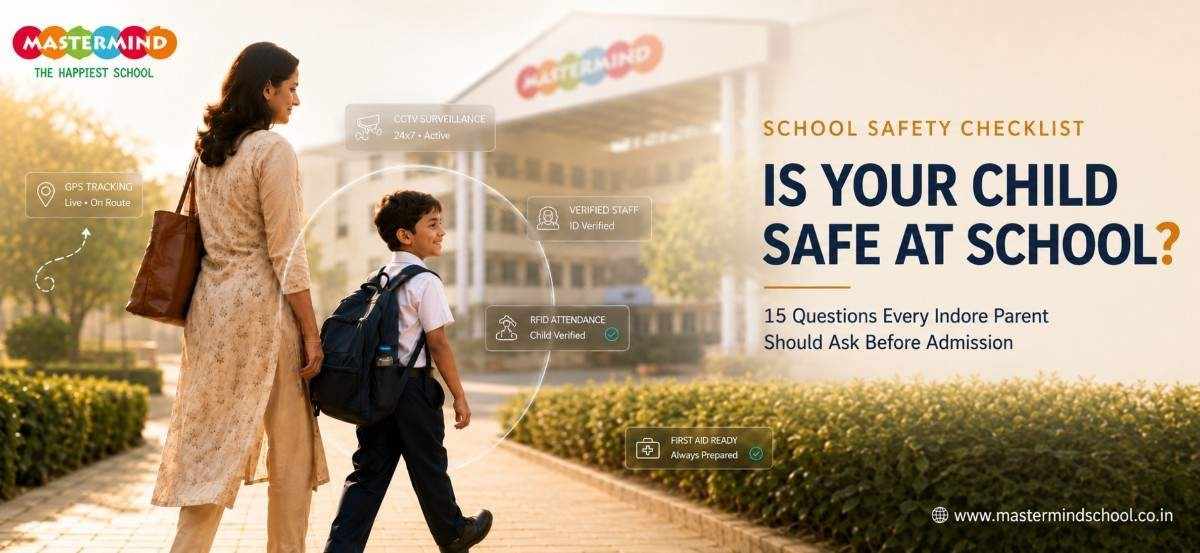
Most school brochures say "safety is our priority." Very few parents know what to actually check. And here's the uncomfortable truth: the Government of India has already written down what a safe school must have — in the NCPCR's Manual on Safety and Security of Children in Schools and the Ministry of Education's school safety guidelines — but most parents have never seen these standards.
This guide turns those official standards into 15 simple questions you can ask on any school tour in Indore. Carry them with you. A good school will love answering them. An evasive answer is an answer.
Why Safety Should Be Your First Filter, Not Your Last
Ask most parents how they shortlist schools and you'll hear: board, results, fees, distance… and then, somewhere near the end, "and of course it should be safe."
Flip that order.
Your child will spend six to eight hours a day, roughly 200 days a year, inside that campus and on that bus — more waking time than anywhere except home. The Ministry of Education's school safety guidelines put it plainly: when a child is in school, the school has actual charge and control of the child, and the responsibility for their safety and security lies squarely with the school authorities.
Academics can improve year to year. Safety systems either exist on day one or they don't. That's why safety belongs at the top of your school-selection checklist — especially for parents of pre-primary children (ages 2–5) who cannot yet describe their day to you.
A simple rule for Indore parents: if a school cannot show you its safety systems working live during a tour, treat every safety claim on its website as unverified.
The 15-Question School Safety Checklist
Take this list with you on every school visit. Tick, don't trust.
Is the campus covered by CCTV — and can you show me?
Don't settle for "yes, we have cameras." Ask what percentage of the campus is covered, whether corridors, gates, playgrounds and bus bays are included, and who monitors the footage. Ask to see the monitoring screen during your tour.
How is entry and exit controlled at the gate?
The NCPCR manual recommends that main gates stay locked after students enter, and that visitors be allowed in only after identity verification. Ask: Can a stranger walk in during school hours? Who verifies visitors? Is there a visitor register or pass system?
How does the school track attendance — and how fast would you know if my child didn't reach class?
Modern schools use RFID-based attendance so a child's presence is logged automatically. The real question: how quickly does the system flag an absence, and does the parent get informed?
Are the building, fire and hygiene certificates current?
CBSE affiliation norms require schools to maintain valid building safety, fire safety, drinking water and hygiene certificates from local authorities. Any CBSE school should be able to show these — many publish them in their online Mandatory Disclosure. Ask for the fire NOC number, not just the word "yes."
Is the campus designed for the age group using it?
For pre-primary children especially: rounded furniture edges, child-height washrooms, soft play surfaces, and separation from older students' areas. A campus built for 14-year-olds is not automatically safe for 3-year-olds — which is why schools with a dedicated pre-primary campus have a structural advantage.
School transport is where most parents worry the most — and where the widest gap exists between schools.
Are the buses school-owned or outsourced?
School-owned buses mean the school directly controls drivers, maintenance and discipline. With outsourced vans and autos, accountability gets blurry. Ask who employs and verifies the driver.
Is every bus GPS-tracked — and can parents see it?
GPS tracking means the school (and ideally you) can see where the bus is in real time. Ask whether the school actively monitors routes and speeds, or whether the GPS exists only on paper.
Is there CCTV inside the bus?
Cameras inside the bus protect children during the one part of the day when no teacher is watching — the commute.
Is there a trained adult attendant — ideally female staff — on every bus?
A driver cannot drive and supervise children at the same time. Official safety guidance and common sense agree: every school bus carrying young children needs an attendant. For pre-primary children, a female attendant ("didi") on every bus is the standard caring parents should insist on.
What is the handover protocol at the stop?
Who is a young child released to at the bus stop? Is there a verification system, or is the child simply dropped? For children under 8, a named-guardian handover rule is a strong sign of a serious safety culture.
Are all staff — including support staff — background-verified?
Teachers, helpers, drivers, cleaners, guards. Ask directly: "Do you do police verification for all staff, including non-teaching staff?" The NCPCR framework treats staff verification as basic, not optional.
What happens if my child gets hurt or falls sick at 11 a.m.?
Listen for specifics: a first-aid room, trained staff, a doctor on call, and a clear parent-intimation protocol. The NCPCR manual is explicit that a sick child must be attended by a certified medical doctor and parents must be informed. Vague answers ("we manage, don't worry") are a red flag.
How does the school communicate with parents during the day?
If something happens — a delay, a minor injury, an early closure — how do you find out? App notification, call, WhatsApp group? How fast?
Does the school run safety drills and teach children about safe/unsafe touch?
Fire drills, evacuation practice, and age-appropriate personal-safety education are part of the national school safety framework. Ask how often drills happen and how personal safety is taught to young children.
Who is accountable — is there a safety in-charge?
In well-run schools, safety has an owner: a designated person or committee that audits systems, not just a line in the brochure.
What the Official Guidelines Actually Require
You're not being a "difficult parent" by asking these questions — you're asking for what national frameworks already prescribe.
| Framework | What it covers | Why it matters to you |
|---|---|---|
| NCPCR Manual on Safety and Security of Children in Schools | Gate control, visitor verification, staff responsibility, health & first-aid protocols, transport supervision | The national baseline every school should meet — CBSE has circulated it to all affiliated schools |
| Ministry of Education, Guidelines on School Safety and Security (2021) | Fixes accountability: the school is responsible for the child's safety while in its charge | Gives you the standing to ask hard questions |
| CBSE affiliation norms | Valid building, fire, water and hygiene safety certificates; transport precautions | Verifiable documents — check the school's Mandatory Disclosure |
If a school looks puzzled when you mention these, that tells you something too.
How to "Audit" Safety on a School Tour — In 30 Minutes
- Arrive 10 minutes early and watch the gate. Is entry controlled or casual?
- Ask to see the CCTV monitoring screen — not photos of cameras.
- Walk to the transport bay. Look inside a bus: GPS unit, camera, first-aid box, attendant seat.
- Visit the washrooms of the class your child will join. Hygiene reflects supervision.
- Ask the 15 questions above and note which get specific answers versus reassurances.
- Cross-check the school's Mandatory Disclosure online the same evening.
Any school that welcomes this audit is a school that has nothing to hide.
How We Approach Safety at Mastermind School, Indore
We wrote this checklist because it's the same one we hold ourselves to. At Mastermind School — a CBSE-affiliated school in East Indore ("Where Happiness Meets Confidence") — safety is engineered into the campus, not added to the brochure. The full system is laid out on our Safety & Transport page:
- 100% CCTV coverage — every classroom and the entire premises, with security staff on campus through the school day.
- RFID-based attendance, so your child's arrival is registered systematically, not just in a manual register.
- School-owned buses — not contracted — with GPS tracking and a CCTV camera recording inside, and a female staff member on every bus from the first pickup to the last drop.
- First aid on campus with a doctor available immediately, plus a counselor and a special educator on staff, and parents called at once.
- Certificates in writing: Fire Safety NOC No. 6100020818, the Building Safety Certificate and the water and sanitation report are published on our Mandatory Disclosure page for any parent to read.
- Age-appropriate campuses: a dedicated Pre-Primary Campus (Play Group–KG II) at Shreeji Valley, Bicholi Mardana, and Mastermind High School (Class 1–10) at Dudhia — so a 3-year-old is never navigating a space built for teenagers.
- Bus routes across East Indore, including Pipliyahana, Kanadia and the colonies around both campuses — so the safe commute starts near your home.
And yes — we genuinely enjoy it when parents arrive with a checklist. Bring this one.
Key Takeaways
- Safety is verifiable — check systems, don't collect promises. Ask to see CCTV monitoring, GPS tracking and certificates live.
- The commute is the most unsupervised hour of a child's day: GPS + in-bus CCTV + a trained (ideally female) attendant is the standard to insist on.
- National frameworks (NCPCR manual, MoE guidelines, CBSE norms) already define what a safe school must have — you're only asking for compliance.
- Ask for document numbers, not assurances: a fire NOC number and a building safety certificate should be published, not described.
- For ages 2–5, age-appropriate campus design matters as much as cameras.
- A school that welcomes your safety audit is showing you its culture, not just its equipment.
Frequently Asked Questions
What safety features should I check before choosing a school in Indore?
Check five things: campus CCTV coverage, controlled gate entry with visitor verification, GPS-tracked transport with an attendant on board, background-verified staff, and first-aid readiness with a doctor on call. Verify each during a school tour rather than relying on the website.
Is CCTV mandatory in schools in India?
National frameworks like the NCPCR school safety manual strongly recommend surveillance and monitored premises, and several states mandate CCTV in schools. Regardless of the legal minimum, full CCTV coverage with active monitoring is the practical standard parents should look for.
How can I check if a school bus is safe?
Ask whether buses are school-owned, GPS-tracked, fitted with CCTV, carry a first-aid box, and have a trained adult attendant on board. Also ask about the driver's verification and the child-handover protocol at stops.
What is RFID attendance in schools?
RFID attendance uses a small tag (usually on the ID card) that automatically logs when a child enters the campus, so the school knows in real time that your child has arrived — without depending on a manual register.
What questions should I ask on a school tour?
Use the 15 questions in this guide, covering campus security, transport, staff verification and emergency readiness. Prioritise questions whose answers you can see demonstrated — like the CCTV monitoring screen or the inside of a school bus.
Who is responsible if something happens to my child at school?
Under the Ministry of Education's school safety guidelines, the school has charge and control of the child during school hours and is responsible for their safety and security. That's why documented systems and protocols matter.
What should a school do if my child falls sick in class?
The NCPCR manual requires that a sick child be attended by a certified medical doctor and that parents be informed. Ask any school you visit to describe its exact medical protocol — first aid, doctor access, and parent intimation.
Are smaller schools less safe than big-brand schools?
Not necessarily. Safety depends on systems, not size or fees. A school with full CCTV, GPS buses with attendants, RFID attendance and verified staff can be safer than a famous school without them. Audit the systems, not the reputation.
Is Mastermind School safe for very young children?
Mastermind School runs a dedicated Pre-Primary Campus (Play Group to KG II) in Bicholi Mardana with 100% CCTV coverage, RFID attendance, secured premises, and school-owned GPS and CCTV buses with a female staff member on board. You're welcome to verify all of it on a campus tour.
How far is Mastermind School from Pipliyahana?
Both campuses sit in East Indore — the Pre-Primary Campus at Shreeji Valley and Mastermind High School near Pitambara Dhaam Mandir — and the school's own bus routes cover Pipliyahana along with other East Indore colonies. Share your exact locality with the school office and they will confirm your nearest pickup point and timing.
Does the school publish its fire and building safety certificates?
Yes. Fire Safety NOC No. 6100020818, the Building Safety Certificate and the water, health and sanitation report are published on the Mandatory Disclosure page. Any CBSE school is expected to publish these, so ask every school on your shortlist for the same documents by number.
When should I start school-hunting for the 2027–28 session?
Start visiting schools 6–9 months before the session begins — in Indore, that means shortlisting between now and December. Popular schools fill seats early, and unhurried tours let you actually run a safety audit instead of a formality visit.
Does a safe school mean a strict, fearful school?
No — the opposite. Children learn best when they feel secure. That's the idea behind happiness-first schooling: strong invisible systems (CCTV, GPS, protocols) so that the visible experience for the child is warm, free and joyful.
How do I verify a school's CBSE affiliation and safety certificates?
Check the school's Mandatory Disclosure page (a CBSE requirement) for the affiliation number and statutory certificates. Mastermind School's CBSE affiliation number is 1031472, and its disclosure is published on its website.
Conclusion
You started reading this because one question sits under every school decision: "Will my child be safe when I'm not there?"
You now have what most parents never get — the actual standard. Fifteen questions, drawn from the same official frameworks schools are supposed to follow. Print them, carry them, and let every school in Indore answer them. The right school won't just tolerate your checklist; it will be proud of its answers.
Because a child who is safe is a child who is free to be happy — and a happy child learns fearlessly.
Sources & official references
- NCPCR — Manual on Safety and Security of Children in Schools: ncpcr.gov.in
- Ministry of Education — Guidelines on School Safety and Security (2021): dsel.education.gov.in
- CBSE — School Safety norms & required certificates: cbse.gov.in
Read next: how to choose a school in Indore, step by step · more parenting guides on the Mastermind School blog · see our campuses in the photo gallery
Come Audit Us
Book a campus visit and run all 15 questions in person — the CCTV room, a bus with its GPS unit and camera, the first-aid room, the certificates.
Book a campus visit Contact the school
Or call +91 81090 55113. Found this useful? Share it with one parent in your society WhatsApp group who is school-hunting right now.
Naveen Chowdhari is a visionary educationist dedicated to redefining the academic landscape in Indore. As the Director of Mastermind School and Mastermind Abacus, he is a firm believer that premium, world-class education should be accessible to every aspiring student. Under his leadership, Mastermind School has become a benchmark for excellence—integrating advanced CBSE pedagogy, Robotics, and Smart-Class technology while maintaining a student-first approach to value. His mission is to empower the next generation of Indore with global skills and traditional roots.