
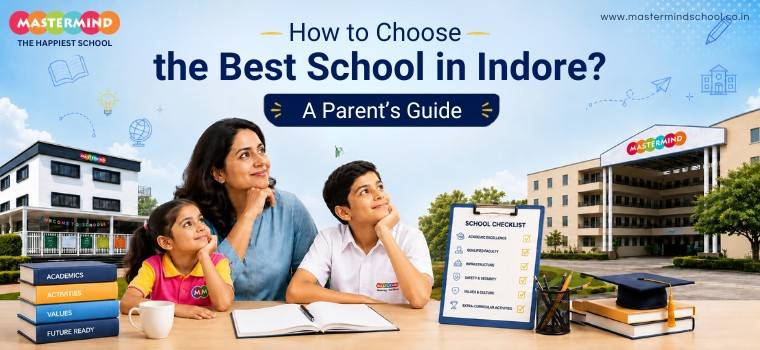
To choose the right school in Indore, start with your child's needs, shortlist three or four schools within a manageable commute, and visit each one on a working day. Watch how teachers speak to children, ask how the school teaches rather than only which syllabus it follows, check safety and transport for your colony, and confirm the school's CBSE disclosures before you pay anything.
Choosing a school is one of the most important decisions parents make for their children. A school is not just a place where children learn subjects like Mathematics, Science, and English. It is the environment where they develop confidence, build friendships, learn values, discover their talents, and form habits that often stay with them for life. For parents in Indore, the decision can feel overwhelming because the city has many schools, each claiming to offer the best education, modern facilities, and excellent results.
When every school promises quality education, how do parents decide which one is truly right for their child? If you live in Bicholi Mardana, Kanadia, Dudhia, or nearby residential areas, you may have already searched online for terms like "best school in Indore," "school near me," or "CBSE school near my location." While these searches can help you create a shortlist, choosing the right school requires looking beyond advertisements and rankings.
The best school is not necessarily the biggest or the most expensive. It is the school where your child feels happy, supported, and motivated to learn. A good school should help your child grow academically, emotionally, socially, and creatively. It should provide an environment where children feel safe, respected, encouraged, and excited to come every day.
Start by Understanding Your Child
Before comparing schools, it is important to understand your child's unique personality and learning needs. Every child is different. Some children are naturally confident and outgoing, while others need more encouragement to express themselves. Some enjoy academics, while others learn better through practical experiences, activities, and creative projects. Parents often spend a lot of time comparing schools but very little time understanding what environment will help their child thrive.
Ask yourself a few simple questions. Does my child need more personal attention? Does my child enjoy learning through activities? Would my child benefit from a smaller and nurturing environment? Is confidence-building important for my child? These answers can help you identify the type of school that will support your child's development most effectively. The right school is the one that understands your child as an individual, not just as another student in the classroom.
Look Beyond the Syllabus
Many parents begin their school search by asking a simple question: "What syllabus does the school follow?" While the curriculum is important, it is only one part of the educational experience. A more valuable question is: "How does the school teach?" Two schools may follow the same curriculum, yet provide completely different learning experiences.
In one classroom, students may spend most of their time memorizing information. In another, children may be actively participating in discussions, projects, experiments, and hands-on activities. The second approach often creates deeper understanding and greater enthusiasm for learning. Across the world, educators are increasingly recognizing that children learn best when they are actively involved in the learning process. Activity-based learning, project-based learning, and experiential learning are becoming essential components of modern education because they help children understand concepts instead of simply memorizing them.
The Importance of Safety and Emotional Well-Being
Academic performance matters, but children cannot learn effectively if they do not feel safe and emotionally secure. When visiting a school, pay attention to more than the classrooms and facilities. Observe how teachers interact with students. Notice whether children appear comfortable, confident, and engaged. A positive school environment should make children feel respected, valued, and supported.
For younger children especially, emotional comfort plays a major role in learning. A caring teacher, a welcoming classroom, and a supportive culture can make a tremendous difference in a child's overall development. Parents are not simply choosing a school; they are choosing a second home for their child. A child who feels emotionally safe is more likely to ask questions, participate in activities, make friends, and develop confidence.
Great Teachers Make Great Schools
Buildings, technology, and infrastructure are important, but teachers remain the heart of every successful school. Think back to your own school days. Chances are that the teachers you remember most are not the ones who completed the syllabus fastest. They are the ones who inspired you, encouraged you, and helped you believe in yourself.
A good teacher understands that every child learns differently. They recognize strengths, identify challenges, and provide guidance that helps children grow academically and personally. When visiting schools, parents should take time to understand how teachers interact with students and how the school supports teacher development and training. The quality of teachers often has a greater impact on a child's future than any building or facility.
Education Is About More Than Marks
Marks are important, but they are not the only measure of success. Today's world requires children to develop skills that go far beyond academics. Confidence, communication, creativity, leadership, teamwork, and problem-solving abilities are becoming increasingly valuable. This is why many parents are now looking for schools that provide opportunities beyond the classroom.
Activities such as robotics, sports, public speaking, art, music, storytelling, reading programs, and creative projects help children discover their interests and build important life skills. Parents searching for the best school in Indore are increasingly seeking schools that focus on the overall development of the child rather than academic achievement alone. A truly good school prepares children not only for exams but also for life.
Why Location Matters More Than You Think
Parents often underestimate the importance of choosing a school close to home. A long daily commute can leave children tired and reduce the time available for rest, family interaction, hobbies, and extracurricular activities. For families in East Indore, where many daily trips run along the busy bypass, selecting a conveniently located school can make daily routines smoother and less stressful.
Easy accessibility also allows parents to participate more actively in school events, meetings, and their child's educational journey. When a school is located close to home, parents can respond quickly when needed, attend important interactions more comfortably, and stay more connected with the school community. A shorter commute also gives children more time for rest, play, reading, and family bonding.
Visit Schools Before Making a Decision
No brochure, website, or social media page can replace a personal school visit. Before finalizing admission, visit the schools on your shortlist. Walk through the campus, observe classrooms, meet teachers, talk to school leaders, and ask questions about teaching methods, safety measures, activities, and communication with parents.
Many parents also find it helpful to check Google reviews and speak with existing parents to gain a better understanding of the school's culture and strengths. Often, a single visit can provide more clarity than hours of online research. During your visit, observe whether children look happy and active, whether teachers speak respectfully, and whether the school environment feels warm, organized, and child-friendly.
Questions Every Parent Should Ask
When visiting a school, parents should not hesitate to ask important questions. You can ask how the school helps children build confidence, how slow learners are supported, what opportunities are available beyond academics, how the school communicates with parents, what safety measures are in place, and how values and discipline are taught.
The answers can reveal whether a school's philosophy aligns with your expectations and your child's needs. A good school will not hesitate to explain its teaching methods, safety systems, activity structure, and parent communication process. These questions also help parents understand whether the school focuses only on performance or truly supports the overall growth of every child.
A School Visit Checklist for Indore Parents
Take the same checklist to every school on your shortlist, so your notes can be compared side by side. Visit on a working day, while classes are running, rather than on a holiday or event day.
| What to check | What a good sign looks like |
|---|---|
| A class in session | Children are talking, doing and asking questions, not only copying from the board. |
| Teaching approach | A teacher can explain how they teach a hard topic, such as fractions, not just which book they use. |
| Teachers and children | Teachers know children by name and speak to them calmly and respectfully. |
| Safety systems | The school can show you its gate checks, cameras, attendance tracking and bus supervision, not just describe them. |
| The daily commute | A bus route covers your colony, with pickup times that still let your child sleep enough. |
| Life beyond academics | Sports, arts, reading and skills such as robotics or coding are part of the regular week. |
| Parent communication | There is a clear way to track progress and reach teachers through the year, not only at result time. |
| Official disclosures | The school website carries a "Mandatory Public Disclosure" page with its CBSE affiliation and staff details. |
Finding the Right Balance
The best schools understand that education is about balance. Children need strong academics, but they also need opportunities to explore, create, communicate, and grow. They need discipline, but they also need encouragement. They need knowledge, but they also need values.
A school that successfully combines academics, activities, life skills, and character development creates a strong foundation for future success. This balance helps children become confident learners, responsible individuals, and emotionally strong human beings. Parents should look for a school that does not put unnecessary pressure on children but still maintains academic seriousness, discipline, and meaningful learning.
How Mastermind School Supports Child Growth
At Mastermind School, we believe that every child deserves an environment where learning is meaningful, engaging, and enjoyable. Our approach focuses on helping children develop not only academically but also socially, emotionally, and creatively. Through activity-based learning, robotics, sports, creative activities, reading programs, meditation, and value-based education, we aim to prepare children for the challenges and opportunities of the future.
With two campuses (the Pre-Primary Campus at Shreeji Valley, Bicholi Mardana, for Play Group to KG-II, and Mastermind High School near Pitambara Dhaam Mandir, Dudhia, for Class 1 to 10) and school buses on published routes across East Indore, we strive to provide a nurturing environment where children can learn with confidence and grow with purpose. Our focus is to create a school experience where children feel encouraged, parents feel connected, and learning becomes a meaningful journey.
Key Takeaways
- Understand your child's personality and learning needs before you compare schools.
- Ask how a school teaches, not only which syllabus it follows.
- Emotional safety and good teachers matter more than the size of the building.
- Look for a balance of academics, activities and life skills.
- Keep the daily commute manageable, and check that a bus route covers your colony.
- Visit every shortlisted school on a working day, with the same checklist.
- Check the school's CBSE Mandatory Public Disclosure before you pay anything.
Frequently Asked Questions
When should parents in Indore start looking for a school?
The CBSE academic session begins in April, and admission age is usually counted as on 31 March, so start shortlisting several months earlier. Visiting schools between October and January gives you time to compare calmly. Many schools close a class once its sections are full rather than on a fixed date, so an early start also gives you more choice.
How many schools should I visit before choosing?
Three or four well-chosen schools is usually enough. Fewer leaves you with nothing to compare, and many more tend to blur together. Shortlist by distance, board and teaching approach first, then visit each one on a working day so you see real classes. Take the same checklist to every visit so your notes are comparable.
How can I check whether a school is genuinely CBSE affiliated?
Ask for the school's CBSE affiliation number, then look for the "Mandatory Public Disclosure" link on its website. CBSE has directed affiliated schools to display this disclosure prominently on their home page. You can also search for the school in CBSE's online directory of affiliated schools. If a school cannot show these details, treat it as a warning sign.
Are school rankings and online reviews reliable?
Use them as a starting point, not a final answer. Rankings often reflect a school's size, age and marketing reach, and a handful of reviews can be outliers in either direction. Look for patterns across many reviews and speak to parents whose children already study there. Above all, trust what you see in a classroom during your visit.
How important is the distance between home and school?
Distance matters more than most parents expect. A long ride means an earlier wake-up and a tired child by evening, especially in Indore's monsoon traffic. Check whether a school bus serves your colony and what the pickup and drop times would be. Also consider whether you could reach the school quickly yourself if your child needed you.
What should I watch for in the teachers?
Notice how teachers speak to children in ordinary moments. Calm, respectful and patient is a good sign. Ask how they support a child who falls behind and how they stretch one who is ahead. Ask too how the school trains its teachers during the year. A confident, specific answer tells you a lot.
My child is shy. What should I ask the school?
Ask how large the classes are, how teachers draw quieter children into discussion, and whether new students get a settling-in period. During your visit, watch how a teacher responds to a child who hesitates to answer. A school that sees your child as an individual will describe specific steps. A generic promise that every child gets attention is not enough.
How do I compare school fees across Indore?
Ask each school for its complete fee structure in writing. It should cover one-time admission charges, the annual fee, how payments are spread, and what costs extra, such as transport, books and uniforms. Compare what is included, not just the headline figure. Mastermind School publishes its full structure on its School Fees page.
Does Mastermind School have Class 10 board results yet?
Not yet. Mastermind High School's first Class 10 batch appears for the CBSE board exam in 2027, so there are no board results to compare. Parents can judge the school by seeing classes in session and meeting teachers. They can also review its Mandatory Disclosure page, which sets out the school's CBSE affiliation details.
Does Mastermind School offer Classes 11 and 12?
Not at present. Mastermind High School currently runs Class 1 to Class 10 under CBSE Affiliation No. 1031472. The school guides Class 10 students through stream selection for Class 11. Because CBSE is a national board, the Class 10 certificate is accepted by CBSE senior secondary schools across Indore and India.
Do I need an appointment to visit Mastermind School?
No appointment is needed. Campus visit hours are Monday to Friday, 2:00 to 4:00 PM, and Saturday, 9:00 AM to 4:00 PM. Bring your child along so you can both see a classroom, meet the teachers and look inside a school bus. The admissions page has the full process.
Does the Mastermind School bus cover Kanadia?
Yes. Kanadia is among the areas on Mastermind School's published bus routes across East Indore. Pickup points differ from colony to colony, so share your exact address when you contact the school. The office will then confirm the nearest stop, the route, and the pickup and drop timings for your area.
Final Thoughts
Choosing the best school in Indore is not about finding the school with the biggest building or the most impressive advertisement. It is about finding a place where your child feels safe, inspired, and excited to learn every day. Take the time to visit schools, understand their teaching philosophy, meet the educators, and observe how children learn.
The right choice will not only shape your child's academic journey but also influence their confidence, character, and future success. If you are a parent in East Indore, visiting nearby schools and understanding their approach to education can help you make an informed decision. At Mastermind School, we always welcome parents to experience our learning environment and discover how we support the overall development of every child.
Visit the Campus
The checklist above works best in person. Bring it along, see a class in session at either Mastermind campus, and judge us by the same standards you would apply to any other school.
Book a campus visit or contact the school to speak with our team.
Author – Mr. Naveen Chowdhari
Naveen Chowdhari is a visionary educationist dedicated to redefining the academic landscape in Indore. As the Director of Mastermind School and Mastermind Abacus, he is a firm believer that premium, world-class education should be accessible to every aspiring student. Under his leadership, Mastermind School has become a benchmark for excellence—integrating advanced CBSE pedagogy, Robotics, and Smart-Class technology while maintaining a student-first approach to value. His mission is to empower the next generation of Indore with global skills and traditional roots.
Last Updated: 03 October 2026