
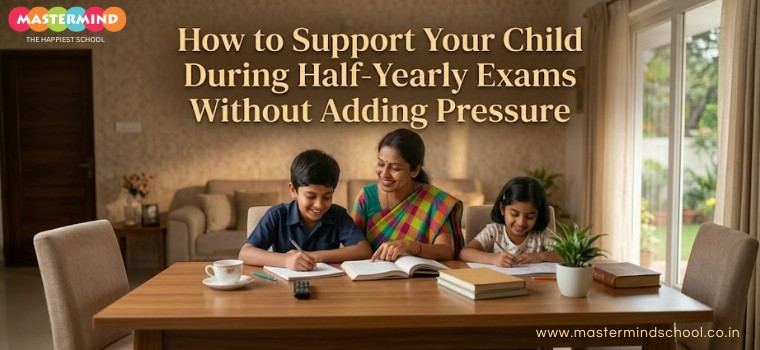
The exam sheet goes up on the notice board, and something in the house shifts. Dinner-table conversation turns to revision. A parent who was calm all year starts asking "Have you studied?" three times an evening. Nobody in the family said the word "pressure" out loud — but everyone can feel it.
If your child's school is in the middle of half-yearly or mid-term exams right now, you're not imagining the tension. Most CBSE schools are holding these exams through September and into October this year, and it's one of the few weeks where a parent's own mood in the house matters almost as much as the child's revision plan.
This guide walks through exactly what that looks like at home this week — what to say, what to avoid, how to tell normal exam nerves from something that needs attention, and why this matters for children well before Class 10, not just during board years.
Why Half-Yearly Exams Feel Bigger Than They Are
Half-yearly exams aren't board exams. There's no public result, no lifelong record, no college depending on this particular paper. And yet, in most Indian households, they generate a surprising amount of tension — often more than the stakes actually justify.
Part of the reason is timing: this is usually the first real academic checkpoint since the school year began, so it becomes a stand-in for a much bigger, unspoken question — "Is my child doing okay?" That question is fair. But when it gets asked through exam marks alone, both the parent and the child end up more anxious than the situation calls for.
What the Research Actually Shows About a Parent's Role
A 2025 study published in Psychiatric Quarterly, which followed over 2,300 parent-teen pairs, found something worth sitting with: parental anxiety doesn't just coexist alongside a teenager's exam stress — it actively contributes to it. The pathway runs through two things: a strained parent-child relationship, and heightened perceived academic pressure. In plain terms, when a parent is anxious, the child usually feels it, even if the parent never says a word about the exam.
Indian mental-health researchers have found similarly high anxiety levels among school students, and specialists consistently point to the same root message: many teenagers say their exam pressure comes primarily from family expectations, not from school or from the exam itself.
The advice from child psychiatrists is consistent too. Dr. Ananya Mahapatra, a psychiatrist quoted in recent CBSE-result coverage, emphasises shifting from a performance-focused mindset to a learning-focused one — treating a result as "a snapshot of knowledge at one moment," not a verdict on the child. That reframe, more than any study schedule, is what most changes the atmosphere at home.
Six Ways to Support Without Adding Pressure
These work together as a set, not a checklist to finish in one evening.
1. Regulate your own reaction first
Before you can help your child stay calm, notice your own tone. If you find yourself anxious about their marks, that's worth managing privately — with your partner, a friend, or simply by naming it to yourself — rather than letting it surface as extra questions or a tense dinner table.
2. Praise the effort, not just the number
"You stuck with that chapter even though it was hard" lands very differently from "Why did you only get this much?" Recognising effort keeps a child's motivation intact even when a result disappoints them.
3. Keep the daily routine boringly normal
Exam week is not the week to overhaul sleep timings, skip meals, or cancel every activity. A steady routine signals to a child's nervous system that this is manageable, not an emergency. If your child is also working on focus and study habits, our companion guide on how CBSE students can improve concentration during exams pairs well with this one.
4. Protect sleep and real breaks over "just one more hour"
Teenagers need roughly 8–10 hours of sleep for their brain to actually consolidate what they revised. Pushing a tired child to study later into the night is one of the least effective forms of "help" available, however well-intentioned.
5. Don't wait for a meltdown to check in
A short, low-pressure check-in most evenings — "How did today feel?" rather than "How much did you cover?" — catches rising stress early, while it's still easy to talk through.
6. Treat movement and hobbies as part of the plan, not a distraction from it
Research on school-age students has found yoga measurably reduces tension and anxiety, and that short movement breaks actually improve focus in the study session that follows. A 15-minute walk or a few minutes of stretching before revision isn't time lost — it's time that makes the next hour more productive.
What to Say (and What to Avoid) This Week
Small phrases carry more weight during exam week than any other time of year. A quick reference:
| Instead of… | Try… |
|---|---|
| "Did you write everything?" (the second they exit the exam hall) | "How are you feeling? Want a snack before we talk about it?" |
| "Sharma aunty's daughter scored higher last year." | "I can see how much effort you put into this one." |
| "If you don't do well, you'll regret it later." | "Whatever the result, we'll figure out the next step together." |
| Silence or visible disappointment after a weak paper | "This paper's done. Let's see what it tells us for the next one." |
| Constant hovering during every study hour | Being nearby and available, without supervising every minute |
Normal Nerves or Something More? Signs to Watch
Some pre-exam butterflies are completely normal and even useful — they sharpen focus. What matters is whether the reaction is occasional or persistent.
| Usually normal | Worth a closer look (lasting 2+ weeks) |
|---|---|
| Mild nervousness the night before a paper | Ongoing sleep disruption or loss of appetite |
| A quieter mood during exam week | Irritability, withdrawal, or frequent tears |
| Occasional "I'm not ready" worry | Repeated headaches, stomachaches, or panic before tests |
| Wanting a bit more study time than usual | Refusing to attend school or study altogether |
If you notice the second column persisting, or your child mentions feeling hopeless or brings up self-harm in any way, treat it as urgent — speak with your child's class teacher or school counsellor promptly, and consider a paediatrician or child psychologist. Asking for help early is a strength, not an overreaction.
Does This Apply to Younger Children Too?
It's easy to assume exam pressure only touches Class 10 and 12 students. In practice, children as young as Class 3 or 4 can absorb a parent's tense tone or an older sibling's board-exam year, even when their own paper has no real stakes attached.
For younger children, the most useful thing a parent can do is keep exams low-key and matter-of-fact — a normal part of school, not a household event. This is exactly the thinking behind Mastermind School's early-years approach at its Junior Campus: building a child's comfort and confidence with school life first, so that later academic checkpoints feel manageable rather than frightening.
How a Happiness-First Classroom Helps
A calmer child concentrates better, not worse — that idea sits at the centre of Mastermind School's "Where Happiness Meets Confidence" approach. Exams are treated as one checkpoint in a much bigger learning journey, not the whole story of a child's ability.
The school's co-curricular programme — including Yoga, Chess, Coding, Robotics, and Olympiad preparation — gives students regular, structured practice at the same calm, sustained focus that exam season demands, in a format that feels like play rather than pressure. Paired with a safe, happiness-first classroom environment across its East Indore campuses, the goal is a child who walks into an exam hall steady, not spiralling.
Key Takeaways
- Manage your own anxiety first — research shows parental stress reaches a child even unspoken, through a strained relationship and heightened academic pressure.
- Praise effort, not just the number on the paper; avoid comparing your child with siblings, cousins, or classmates.
- Keep sleep, meals, and routine steady during exam week — it signals safety more than any extra revision hour does.
- Movement, yoga, and real breaks aren't a distraction from studying — they measurably improve focus and reduce tension.
- Occasional nerves are normal; sleep disruption, withdrawal, or panic lasting more than two weeks is worth a closer look.
- Exam pressure reaches younger children too, through tone and household mood — keep early exams low-key.
- If your child mentions hopelessness or self-harm, treat it as urgent and involve the school counsellor or a professional promptly.
Frequently Asked Questions
How can parents help reduce their child's exam stress?
Stay calm around your own reaction to marks, praise effort over scores, keep the daily routine (sleep, meals, breaks) steady, and talk about the exam as one checkpoint rather than a verdict on your child's ability. Children read a parent's anxiety more than their words.
What should parents avoid saying to a child before or after an exam?
Avoid comparing scores with siblings, cousins, or classmates, avoid questions like "Did you write everything?" the moment they walk out, and avoid tying love or pride visibly to a number. These are the most common triggers experts flag.
Are CBSE half-yearly exams happening in September 2026?
Yes. CBSE does not set one national date, so each affiliated school prepares its own timetable, but most half-yearly or mid-term exams for Classes 9 to 12 are being held through September and into October 2026, with results generally out by the end of October.
Does a parent's own stress actually affect a child's exam anxiety?
Research published in 2025 studying over 2,300 parent-teen pairs found parental anxiety increases adolescent anxiety indirectly, by straining the parent-child relationship and raising perceived academic pressure. Managing your own reaction is genuinely protective for your child.
What are signs of unhealthy exam stress in a child, not just normal nerves?
Watch for sleep disruption, loss of appetite, irritability or withdrawal, frequent headaches or stomachaches, and panic before tests lasting more than about two weeks. Occasional pre-exam butterflies are normal; a persistent pattern across weeks is worth addressing.
Should I sit with my child while they study for half-yearly exams?
Being available (for a question, a snack, or a check-in) helps more than supervising every minute. Constant hovering can raise pressure and signal you don't trust them to manage it, while total absence can feel like indifference. Aim for present but not policing.
Is exam pressure a problem even for younger children, not just Class 10 or 12?
Yes, though it looks different. Primary-age children can pick up stress from a parent's tone or a sibling's board-exam year even when their own paper carries no real stakes. Keeping early exams low-key and encouraging protects their relationship with learning long before Class 10 arrives.
How much should half-yearly exam marks actually matter?
Half-yearly exams are a progress checkpoint for the school and the child, not a board exam and not a final verdict. They're most useful as a diagnostic — showing which chapters need more work before the next term — rather than a number to react to.
What if my child refuses to study or seems to have given up during exam time?
This is often avoidance driven by fear of failing rather than laziness. A calm conversation about what feels overwhelming, breaking revision into small named tasks, and involving a teacher if it continues usually works better than pressure or punishment.
Can yoga or co-curricular activities genuinely reduce exam anxiety?
Studies on school-age students have found yoga measurably reduces tension and anxiety, and structured breaks with movement improve sustained focus in the next study session. It's a genuine tool, not a distraction from revision.
When should a parent seek professional help for exam-related stress?
Seek support promptly if your child shows persistent sleep or appetite disruption, panic attacks, refuses to attend school, mentions self-harm, or seems withdrawn and hopeless for more than two weeks. A school counsellor, paediatrician, or child psychologist can help early rather than later.
Does Mastermind School help reduce exam pressure for students?
Mastermind School's happiness-first classrooms treat exams as one checkpoint, not the whole picture, and its co-curricular programme — Yoga, Chess, Coding, Robotics, and Olympiad preparation — builds genuine focus and calm alongside academics, in a low-anxiety environment.
Where is Mastermind School located, and which classes does it teach?
Mastermind School is a CBSE-affiliated school with campuses across East Indore, educating children from Play Group to Class 10 under its "Where Happiness Meets Confidence" philosophy. Visit the High School page or contact the school for current campus details.
Conclusion
Half-yearly exams will come and go every year — what stays with your child much longer is how it felt to face them at home. A steady routine, a calm parent, and a conversation that values effort over marks do more for a child's confidence than any extra hour of last-minute revision.
None of this asks you to care less about how your child does. It asks you to show that care in a way that steadies them instead of adding to the weight they're already carrying — which is exactly the kind of confident, happy "I Can" mindset Mastermind School tries to build in every classroom, every single day.
See This Approach in a Classroom
Curious what a genuinely happiness-first, low-pressure CBSE classroom looks like day to day?
Schedule a School Tour Explore Our CBSE ProgrammeNaveen Chowdhari is a visionary educationist dedicated to redefining the academic landscape in Indore. As the Director of Mastermind School and Mastermind Abacus, he is a firm believer that premium, world-class education should be accessible to every aspiring student. Under his leadership, Mastermind School has become a benchmark for excellence—integrating advanced CBSE pedagogy, Robotics, and Smart-Class technology while maintaining a student-first approach to value. His mission is to empower the next generation of Indore with global skills and traditional roots.