
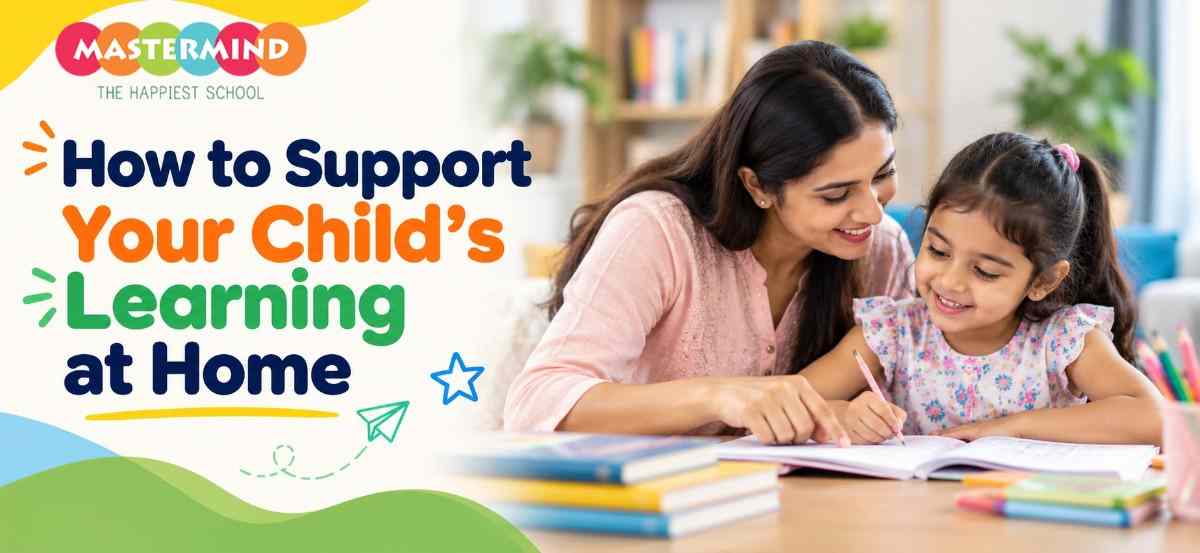
You support your child's learning at home less by teaching and more by building a few daily habits: real conversation, a short story or reading time, a fixed homework slot, enough sleep, and regular contact with the class teacher. None of this needs a tutor's skill or a spare room. It needs about thirty minutes of your attention on most days.
Many parents in Indore tell us the same thing: "I want to help, but I don't know the new syllabus, and by the time I am home it is already late." That worry is understandable, and it is mostly misplaced. Your child's teacher handles the syllabus. What home adds is something a classroom cannot: one adult, one child, and unhurried talk.
This guide covers seven habits that work from Play Group to Class 10, what changes with age, and when to speak to the school.
What does "supporting learning at home" really mean?
It does not mean re-teaching the day's lessons or sitting beside your child for two hours. A child who has spent a full day at school does not need a second school in the evening.
It means three things. Your child feels that learning matters in your home. They have a predictable time and place to do their work. And they know someone is interested in what they think, not only in what they scored.
CBSE is also moving in this direction. Papers now carry more application-based questions, which reward a child who understands and can explain, not one who has memorised. You can read how this works in the classroom on our CBSE curriculum and teaching page. Habits like conversation and reading build exactly that kind of understanding.
Which home habits make the biggest difference?
1. Talk with your child, not at them
Dinner is the easiest classroom in the house. Put the phones away and ask questions that cannot be answered with "fine" or "nothing". Try "What made you laugh today?" or "What was the hardest thing your teacher asked?"
The back-and-forth matters more than the number of words. A 2018 MIT study published in Psychological Science found that, among children aged 4 to 6, the number of conversational turns with an adult was linked to stronger language skills, whatever the family's income or education. So let your child finish the sentence, then ask one more question.
2. Tell stories and read aloud
Kahaniyan are the oldest vocabulary lesson we have. A story from a grandparent, a chapter read aloud at bedtime, or a folk tale told on a power-cut evening in the monsoon all give a child new words in a setting they enjoy.
The language does not matter. Hindi, Malwi, Marathi, Sindhi or English all build the same thinking skills. Stop in the middle and ask, "What do you think happens next?" Once your child can read, take turns: you read a page, they read a page.
3. Fix a time and a place for homework
A study corner works as well as a study room. A table near a window, a small shelf for books, and the television off is enough. What matters is that it is the same place at the same time every day.
Children who travel home by school bus to areas such as Kanadia or Pipliyahana often reach by late afternoon. Give them a snack and some free play first. Homework goes better after a break than straight off the bus.
4. Let them struggle a little before you help
When your child says "I can't do this," wait before you pick up the pencil. Ask them to read the question aloud, then ask what they have tried. Often they solve it while explaining.
If you give the answer, the homework gets finished but the learning does not happen. We wrote more about this in the "I Can" approach to raising independent children.
5. Protect sleep and limit screens
A tired child cannot learn, however good the school. The American Academy of Sleep Medicine recommends 10 to 13 hours of sleep for children aged 3 to 5 (including naps), 9 to 12 hours for ages 6 to 12, and 8 to 10 hours for teenagers. It also notes that regularly sleeping less is associated with attention, behaviour and learning problems.
Screens are the usual reason bedtime slips. The Indian Academy of Pediatrics guidelines advise no screen exposure below 2 years, a maximum of one hour of supervised screen time a day for ages 2 to 5, and less than two hours a day for ages 5 to 10. For a practical family plan, see our guide to screen time management.
6. Turn everyday chores into learning
Maths and science are already in your house. Let your child weigh the vegetables at the sabzi mandi and work out the change. Ask them to measure the poha and water for breakfast. Let them read the electricity bill, the bus route board, or the ingredients on a biscuit packet.
These are small things, but they show a child that what they learn in class is used in real life. That is the question competency-based papers now ask.
7. Stay in touch with the teacher
You see your child at home; the teacher sees them among thirty others. Put the two views together and you get the full picture. Attend parent-teacher meetings, read the notes the school sends, and tell the teacher early if something has changed at home.
Ask specific questions. "How is she doing?" gets a general answer. "Does she ask questions in class?" or "Where does he get stuck in maths?" gets a useful one.
How much should you help at each age?
The help a four-year-old needs is very different from what a Class 8 student needs. The homework figures below are from the Ministry of Education's School Bag Policy 2020, which recommends upper limits by class. Your child's school will set its own pattern within its timetable.
| Stage | What helps most at home | Homework guidance (School Bag Policy 2020) |
|---|---|---|
| Play Group to KG-II | Talk, rhymes, stories, sorting and counting games. No formal study. | No homework recommended |
| Class 1–2 | Read together daily. Let them read signboards, labels and menus. | No homework recommended |
| Class 3–5 | A fixed homework slot. The child packs their own bag and tells you what they read. | Up to 2 hours a week |
| Class 6–8 | A weekly planner and a revision day. You check the plan, not every answer. | Up to 1 hour a day |
| Class 9–10 | A quiet space, steady sleep, and a parent who listens more than instructs. | Up to 2 hours a day |
If your child is about to start school, our guide on how to prepare your child for preschool covers the early years in more detail.
What should you avoid doing?
Most mistakes come from caring too much, not too little. These swaps keep the care and remove the pressure.
| Instead of | Try |
|---|---|
| "How many marks did you get?" | "Which question did you find interesting?" |
| Doing the project yourself so it looks neat | Letting them make it, uneven edges and all |
| Comparing with a cousin or classmate | Comparing with their own work from last month |
| Homework the moment they get home | Snack and play first, then a fixed slot |
| Screen as a reward for studying | Outdoor play or a story as the reward |
| Correcting every mistake at once | Picking one thing to improve this week |
Exam weeks test these habits the most. Our article on supporting your child during half-yearly exams without adding pressure shows how to keep the routine steady when the stakes feel higher.
How does Mastermind School work with parents?
Mastermind School follows the CBSE curriculum with a child-centric approach aligned to NEP 2020. Concepts are taught by doing, in the Science, Math, English, Computer and Robotics labs, so that children come home able to explain what they did, not only what they copied.
In the early years at our pre-primary in Indore, learning is play- and activity-based, with Jolly Phonics and a Reading & Writing Program. From Class 1 at Mastermind High School in Dudhia, skills such as Abacus, Coding and Olympiad preparation run inside the regular timetable.
Every student has an individual school app account, and the school holds parent-teacher interactions through the year. If you are unsure how to help with a particular subject, the class teacher is the right person to ask.
Key Takeaways
- Your job at home is to build habits, not to re-teach the syllabus.
- Back-and-forth conversation builds language more than simply hearing many words.
- Stories and reading aloud work in any language your family speaks.
- A fixed time and place for homework matters more than a separate study room.
- Wait before helping; a little struggle is where learning happens.
- Sleep and screen limits affect attention the next day in class.
- Share what you see at home with the teacher, and ask specific questions.
Frequently Asked Questions
How can I support my child's learning at home if I don't know the syllabus?
You do not need to know the syllabus. Ask your child to explain what they learnt, listen, and ask one follow-up question. Explaining a topic aloud is one of the best ways to understand it. Keep a fixed homework time, read or tell stories together, and leave subject doubts to the class teacher.
How much time should a child spend on homework each day?
The Ministry of Education's School Bag Policy 2020 recommends no homework up to Class 2, up to two hours a week for Classes 3 to 5, up to one hour a day for Classes 6 to 8, and up to two hours a day for Classes 9 to 12. If your child regularly needs much longer, speak to the class teacher.
Should I sit with my child while they do homework?
Stay nearby for younger children, but do not hover. Be available for questions while doing your own work, such as reading or cooking. By Class 3 or 4, aim for your child to start and finish alone, with you checking only that the work is done. Independence in homework is a skill in itself.
Is it fine to speak Hindi at home if my child studies in an English-medium school?
Yes. A strong home language supports learning in every other language. NEP 2020 also recognises that young children grasp ideas best in the language they speak at home. Talk, tell stories and explain things in whichever language you are most fluent and natural in. English will grow at school and through reading.
How do I build my child's vocabulary at home?
Talk at mealtimes, tell stories, and read aloud every day. When a new word comes up, explain it with an example from your child's own life and use it again the next day. Ask open questions that need a full sentence in reply. Vocabulary grows through conversation, not through memorising word lists.
What can working parents do when they get home late?
Protect twenty to thirty minutes, not the whole evening. Dinner without phones and a short bedtime story cover the two most valuable habits. Ask a grandparent or caregiver to keep the homework slot fixed. On weekends, involve your child in shopping, cooking or a library visit. Consistency matters more than the number of hours.
How much screen time is reasonable on a school day?
The Indian Academy of Pediatrics advises no screens below 2 years, a maximum of one supervised hour a day for ages 2 to 5, and less than two hours a day for ages 5 to 10. Keep screens out of mealtimes and the hour before bed, so that sleep and conversation are not the first things lost.
My child refuses to study at home. What should I do?
First check the basics: hunger, tiredness, and whether the work is too hard or too easy. Then shorten the slot and make the start easy, with ten minutes on one small task. Praise the effort, not the result. If the refusal continues for weeks, tell the class teacher, who may be seeing the same thing in school.
How does Mastermind School keep parents informed about their child's progress?
Every student at Mastermind School has an individual school app account, and the school holds parent-teacher interactions through the year. Assessment follows the CBSE pattern for each class. Parents who want guidance on supporting a particular subject at home can speak directly to the class teacher at either campus.
Does the Mastermind School bus cover Pipliyahana?
Yes, the school's bus network covers Pipliyahana along with several other areas of East Indore. Pick-up points and timings can change from session to session, so please contact the school office to confirm the nearest stop for your home. Details of the transport and safety arrangements are on our safety and transport page.
Conclusion
Supporting learning at home is not about more worksheets or longer study hours. It is about a home where questions are welcome, stories are told, sleep is protected, and a child is trusted to try before being helped.
Pick one habit from this list and keep it for a month. Dinner without phones is a good place to start. The rest tend to follow once the first one is in place.
Visit the Campus
If you would like to see how classroom learning and home habits fit together, come and watch a class in session. Our teachers will be glad to talk through what your child is learning and how you can support it at home.
Book a campus visit or contact the school to speak with our team.
Author – Mr. Naveen Chowdhari
Naveen Chowdhari is a visionary educationist dedicated to redefining the academic landscape in Indore. As the Director of Mastermind School and Mastermind Abacus, he is a firm believer that premium, world-class education should be accessible to every aspiring student. Under his leadership, Mastermind School has become a benchmark for excellence—integrating advanced CBSE pedagogy, Robotics, and Smart-Class technology while maintaining a student-first approach to value. His mission is to empower the next generation of Indore with global skills and traditional roots.
Last Updated: 06 October 2026