
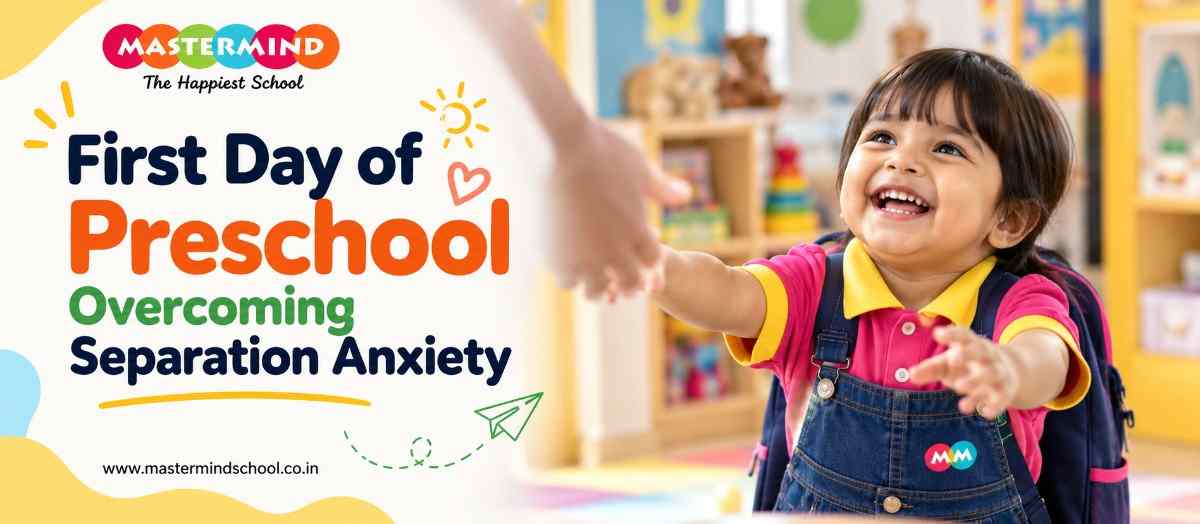
Separation anxiety on the first day of preschool is normal, and for most children it eases once drop-off becomes predictable. What helps most is preparation in the week before, a short goodbye ritual that is the same every morning, never sneaking away, and a calm parent. Expect some tears in the first days; they usually say more about attachment than about the school.
In Indore, the pre-primary session begins in April. For many children it is the first time they spend a few hours away from parents and grandparents, and the first time the family's morning has a fixed clock. Both the child and the adults are adjusting.
This guide covers what to do before the first day, at the school gate, and during the first few weeks. If you are still at the planning stage, our guide on how to prepare your child for preschool is a useful companion.
Rohan's First Day
Picture a common first morning. Three-year-old Rohan, from Pipliyahana, holds on to his mother at the classroom door, unsure about his first day at preschool. At home they had practiced a special goodbye handshake all week.
When the moment comes, Rohan does the handshake, and his grip loosens as he slowly starts to look around his new classroom. His mother stays calm, says she will be back after school, and leaves. The ritual did not stop the nervousness. It gave Rohan something familiar to hold on to while the nervousness passed.
Understanding Separation Anxiety in Preschoolers
Separation anxiety is a normal developmental stage for young children. It manifests as distress and fear when a child is separated from their primary caregivers.
The American Academy of Pediatrics describes it as an entirely normal behavior and a sign of a meaningful attachment, and notes that it varies widely from one child to another. Some children cry for a few mornings, some take longer, and some walk in happily and then struggle in the second or third week.
In practice it looks like crying, clinging, refusing to enter the classroom, or complaining of a stomach ache on school mornings. None of this means your child is not ready for school, or that you chose the wrong one.
Preparing Kids for Preschool
Adjusting Sleep Cycles:
Ensure your child is well-rested by aligning their sleep schedule with school timings a week before school starts. A well-rested child is more likely to be receptive and less irritable.
Explaining School Activities:
Discuss the positive aspects of school life, focusing on the fun activities, games, and new friendships. Keep the conversation light and optimistic.
Meeting the Teacher:
Use open house opportunities to familiarize your child with their teacher. Inform the school about any medical concerns in advance.
Visiting the School:
Tour the school with your child to familiarize them with the new environment. This helps in reducing fear of the unknown.
Maintaining a Positive Mindset:
Your confidence and calm demeanor are crucial. Children often mirror their parents' emotions.
Belongings:
Introduce school bags, water bottles, and lunch boxes a few days before school starts. Familiarity with these items can be comforting.
Handling Preschool Drop-Off
Creating a Goodbye Ritual:
Establish a quick, reassuring goodbye ritual. This could be a special hug, a fun phrase, or a handshake, as Rohan and his mother did. This ritual provides a sense of security and predictability.
Avoid Sneaking Away:
Always say goodbye. If necessary, stay for a while, gradually reducing the time you spend at drop-off. This helps your child adjust to the idea of being without you in a safe and gradual manner.
Bringing Comforting Objects:
A small reminder of home, like a favorite toy or a family photo, can provide emotional support and a sense of continuity.
Avoiding Comparisons:
Every child adapts at their own pace. Respect and support your child's individual process.
Reinforcing Return:
Consistently remind your child that you will return to pick them up. This reassurance builds trust and security.
What Should You Do and Avoid at the School Gate?
Most of the advice above comes down to a few choices made in the two minutes at the gate. This table puts them side by side.
| Do this | Avoid this |
|---|---|
| Use the same short goodbye ritual every morning | Long goodbyes with repeated hugs and returns |
| Say goodbye clearly, then leave | Slipping away while your child is distracted |
| Tell your child when you will be back, in their terms ("after lunch") | Vague promises such as "I will come soon" |
| Hand your child to the teacher and trust her to take over | Coming back into the room when you hear crying |
| Keep your own face and voice calm | Showing your worry, or crying in front of your child |
| Arrive on time so the morning is unhurried | Comparing your child with one who walked in smiling |
Aanya's Journey
Here is another familiar pattern. Little Aanya, from Kanadia, found long goodbyes the hardest part. The more her parents lingered at the door, the more upset she became.
Her parents learned that keeping farewells short and sweet made a significant difference. A quick hug, a cheerful "See you soon!" and a confident exit helped Aanya understand that goodbyes weren't something to fear.
Tips for Parents
Settling Time:
It can take several days for a child to adjust. Be patient and understand that tears are a normal part of this process.
Positive Talk:
Avoid speaking negatively about the school or teachers in front of your child. Maintain a positive narrative to foster a healthy attitude towards school.
Understanding Teacher's Procedures:
Familiarize yourself with the school's approach to handling upset children. This knowledge can be reassuring for you and your child.
Avoiding Surprise Visits:
Frequent check-ins can increase anxiety. Trust the process and the school's ability to care for your child.
Self-Reassurance:
Remind yourself of the long-term benefits of preschool education for your child's development.
Patience is Key:
Remember, transitioning to preschool is a journey that takes time, understanding, and patience.
How Long Does It Last, and When Should You Ask for Help?
There is no fixed number of days. Many children settle once the routine becomes familiar, and it is common for tears to return briefly after a weekend, a holiday or an illness. The first few weeks matter more than the first day, which is why we wrote separately about why the first month of school matters most.
Speak to the class teacher first if the crying is not reducing at all after a few weeks. She sees your child after you leave and can tell you how long the distress actually lasts. Very often it ends within minutes of the goodbye.
Speak to your pediatrician if the anxiety is intense, continues for a long time, and affects sleep, eating or everyday activities. The American Academy of Pediatrics notes that it is rare for separation anxiety to persist on a daily basis after the preschool years, so anxiety that does persist deserves a professional opinion.
How Does Mastermind School Help Children Settle In?
Mastermind School's Pre-Primary Campus in Shreeji Valley, Bicholi Mardana runs Play Group to KG-II for children aged 2 to 5. The pre-primary day is short, from 9:30 AM to 1:30 PM, which suits children who are new to being away from home. You can read about the classes and the daily routine on our play school in Indore page.
In the initial days, teachers use engaging activities, positive reinforcement and gradual separation to help children adjust. A Parent Orientation Programme is held before the session begins, so parents know the routine and the teaching approach in advance.
For parents, the hardest part is often not knowing what happened after the goodbye. The campus has CCTV coverage and RFID attendance, so you know when your child has reached school. Details are on the safety and transport page.
The school's approach also focuses on building an "I Can" attitude from the early years. Small acts of independence at home, such as carrying their own bag, make the classroom feel less overwhelming. Our article on the I Can approach to raising independent children explains how.
Key Takeaways
- Separation anxiety at the start of preschool is a normal developmental stage, not a sign that something is wrong.
- Start preparing a week ahead: sleep timings, a school visit, and familiar bags and bottles.
- Use one short goodbye ritual and repeat it every morning.
- Always say goodbye. Never slip away while your child is distracted.
- Tell your child when you will return, and be there when you said you would.
- Children settle at different speeds. Avoid comparisons.
- If intense anxiety continues for weeks and affects daily life, talk to the teacher and your pediatrician.
Frequently Asked Questions
How long does separation anxiety last when a child starts preschool?
It varies widely from child to child. Many children settle once the morning routine becomes familiar, while others need a few weeks. Tears can also return briefly after weekends or holidays. A steady routine and a short, consistent goodbye help most. If there is no improvement at all after several weeks, speak to the class teacher.
Is it normal for my child to cry at drop-off every day?
Yes, in the early days it is common. Crying at the moment of goodbye is how young children express that they will miss you. Ask the teacher how long it continues after you leave. If your child calms down within a few minutes and joins the activities, the adjustment is going well even if the mornings feel hard.
Should I stay in the classroom until my child stops crying?
Staying for a short while on the first days can help, but reduce that time gradually. Lingering usually stretches out the distress, because your child keeps hoping you will stay. A calm, brief goodbye followed by a confident exit gives a clear message that school is safe and that you will come back.
Is it okay to leave quietly while my child is distracted?
No. It may avoid tears that morning, but a child who suddenly finds a parent gone can become more watchful and clingy the next day. Always say goodbye, tell your child when you will return, and then leave. Predictable goodbyes build the trust that makes separation easier over time.
My child was fine in the first week but is crying now. Why?
This is common. In the first days everything is new and exciting. Once the novelty fades, the child realizes that school happens every day, and the protest begins. It can also follow a weekend, a holiday or an illness. Keep the routine and the goodbye ritual unchanged, and it usually passes.
Can my child carry a toy or comfort object to school?
A small reminder of home, such as a soft toy or a family photo, can comfort a child during the first days. Check with the class teacher first, since schools have their own guidelines on what children may bring. Choose something small and replaceable, and label it with your child's name.
Is two years too young to start Play Group?
Not if the programme is designed for that age. At two, short play-based hours with rhymes, free play and motor activities help children get used to other adults and children. It is a soft start, not an academic programme. Age criteria are listed on the admissions page.
How does Mastermind School help new children settle?
At the Pre-Primary Campus, teachers use a warm welcome, engaging activities, positive reinforcement and gradual separation to help new children adjust. A Parent Orientation Programme is held before the session begins, so parents understand the routine. You can ask the class teacher how your child is settling at any point in the first weeks.
Does the Mastermind School bus cover Pipliyahana for pre-primary children?
Yes, the school's bus routes cover the area. Buses are GPS-tracked and have a female staff member on board. Many parents prefer to drop their child themselves for the first few days and move to the bus once the child has settled. Contact the school to find the pickup point nearest to your home.
When should I speak to a doctor about separation anxiety?
Speak to your pediatrician if the anxiety is intense, continues for a long time without easing, and interferes with sleep, eating or daily activities, or if it appears suddenly in a child who had settled well. Most separation anxiety is a passing phase, but persistent distress deserves a professional opinion.
Conclusion
As you embark on this exciting journey with your child, remember that the right preschool can make a significant difference in easing the transition and laying a strong foundation for your child's future. Whether it's through creating comforting goodbyes, understanding each child's unique pace, or choosing a nurturing environment like Mastermind School, every step you take is a move towards a confident and happy preschooler.
The tears of the first week are rarely remembered by the child. What stays is the routine you built together: a goodbye they can count on, and a parent who always comes back.
Facebook: Mastermind School
Visit the Campus
A campus visit before the first day is one of the simplest ways to reduce fear of the unknown. Bring your child along to see the classrooms and meet the teachers at the Pre-Primary Campus.
Book a campus visit or contact the school to speak with our team.
Author – Mr. Naveen Chowdhari
Naveen Chowdhari is a visionary educationist dedicated to redefining the academic landscape in Indore. As the Director of Mastermind School and Mastermind Abacus, he is a firm believer that premium, world-class education should be accessible to every aspiring student. Under his leadership, Mastermind School has become a benchmark for excellence—integrating advanced CBSE pedagogy, Robotics, and Smart-Class technology while maintaining a student-first approach to value. His mission is to empower the next generation of Indore with global skills and traditional roots.
Last Updated: 06 October 2026