
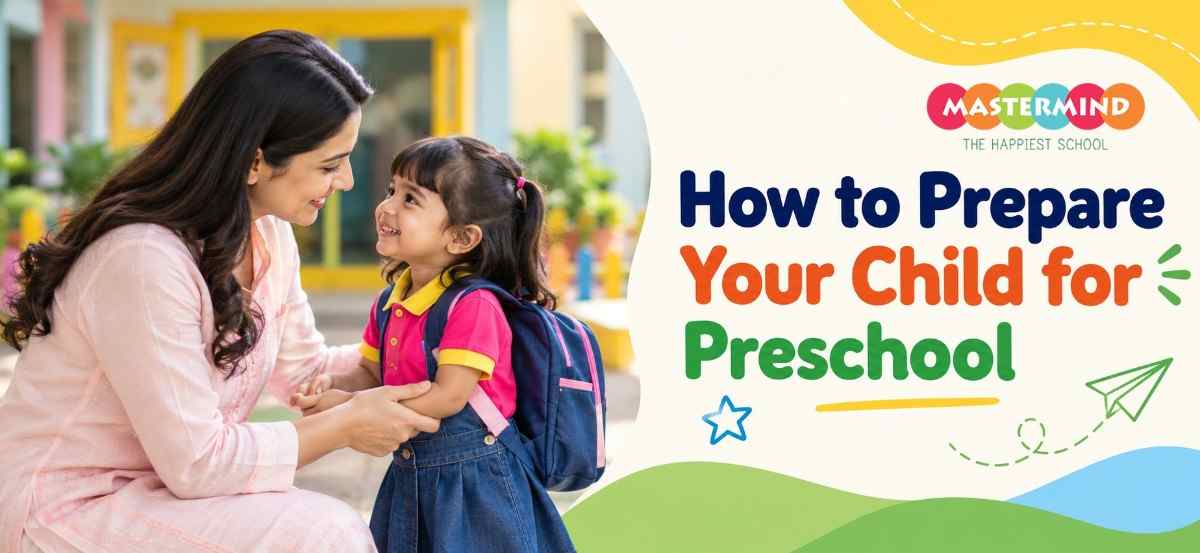
To prepare your child for preschool, start four to six weeks before the first day. Talk about school in a positive way, move sleep and meal times closer to the school day, practise small self-care tasks such as handwashing and eating without help, rehearse short separations, and visit the school together. Your child does not need to know letters or numbers first.
Starting preschool is a big milestone for both children and parents. It's a time of excitement, but it can also be a time of anxiety. After all, this is the first time your child will be away from you for an extended period of time.
If you're feeling overwhelmed, don't worry. There are a few things you can do to help prepare your child for preschool. By following these tips, you can make the transition as smooth as possible for both of you.
In Indore, the new school session begins on 1 April, so late February or early March is a sensible time to begin. That gives your child a few calm weeks to get used to new timings before the first morning at the school gate.
When should you start preparing your child for preschool?
A month or so is enough for most families. Small children cope better with slow, repeated changes than with one big change in the last week. The plan below spreads the work out so nothing feels sudden.
| When | What to do |
|---|---|
| 4–6 weeks before | Start talking about school. Read picture books about school. Begin moving bedtime earlier, a little at a time. |
| 2–3 weeks before | Practise self-care skills every day. Leave your child with a grandparent or relative for an hour or two, and come back when you said you would. |
| 1 week before | Follow the full school-day routine at home. Visit the school or drive past it. Let your child choose the bag and water bottle. |
| The night before | Pack the bag together, keep the evening quiet and get your child to bed on time. |
| The first few weeks | Keep goodbyes short and the same every day. Expect some tears. Stay in touch with the class teacher. |
How do you prepare your child for preschool? 6 steps
1. Talk to your child about preschool
One of the best things you can do to prepare your child for preschool is to talk to them about it. Explain what preschool is, what to expect, and why it's important. You can also read books about preschool together and visit the preschool with your child before they start.
Be specific and honest. Tell your child what will happen in order: "We will go to school, you will play and sing with your teacher, you will eat your tiffin, and then I will come to take you home." Small children worry less when they know how the day ends.
Avoid using school as a warning. Lines like "your teacher will scold you if you do this" teach a child to fear a place they have not even seen yet.
2. Help your child develop a routine
Having a routine can help children feel more comfortable and secure. Start establishing a preschool routine a few weeks before your child starts. This includes waking up and going to bed at the same time each day, eating regular meals and snacks, and having a set time for play and learning.
Sleep matters most here. The American Academy of Sleep Medicine recommends 10 to 13 hours of sleep in 24 hours, naps included, for children aged 3 to 5, and 11 to 14 hours for children aged 1 to 2. A tired child finds every new thing harder, so fix bedtime first and the mornings will follow.
3. Teach your child basic self-care skills
Your child does not have to master everything before the first day. Teachers and helpers support small children with all of this. But a child who has tried these things at home feels far more sure of themselves in a new room. Practise a little every day and let your child do it slowly, even when it is quicker to do it yourself.
- Washing hands with soap before eating and after using the toilet.
- Eating without help – holding a spoon, opening the tiffin box, finishing a small meal while sitting in one place.
- Drinking from their own bottle and closing it again.
- Using the toilet, or telling an adult when they need to go. If toilet training is still in progress, tell the teacher openly.
- Putting on and taking off shoes, and pulling clothes up and down.
- Tidying up – putting toys back in a box after play.
- Asking for help in simple words: "I am thirsty", "I want to go to the toilet", "I am hurt".
- Waiting and sharing – taking turns in a simple game with you or a sibling.
4. Help your child feel confident
It's important for your child to feel confident before they start preschool. Let them know that you believe in them and that you're excited for them to start this new chapter in their lives. You can also help them build their confidence by praising them for their accomplishments and by helping them to learn new skills.
Praise the effort, not only the result: "You put your shoes on by yourself" works better than "good boy" or "good girl". This is the idea behind the "I Can" approach to raising independent children, which we follow in our classrooms too.
5. Be patient and understanding
It may take some time for your child to adjust to preschool. Be patient and understanding, and offer your support and encouragement. If you have any concerns, talk to your child's preschool teacher.
Crying at drop-off is common in the first weeks and does not mean you chose the wrong school or started too early. Keep the goodbye short and the same each day – a hug, a wave, "I will come back after lunch" – and then leave. Never slip away without saying goodbye; it makes the next morning harder.
Your own feelings count as well. Children read our faces very closely, so a calm, smiling goodbye helps even when you feel like crying yourself. Our guide to separation anxiety on the first day of preschool covers this in more detail.
6. Choose a preschool that suits your child
Preparation is easier when the school is a good fit. When you visit, look beyond the building. Ask how teachers help new children settle, how many children are in a class, how clean the washrooms are, and how the school keeps parents informed.
Think about the daily journey too. For a two- or three-year-old, a long ride across the city or along the bypass at peak hour is tiring. A school close to home, or on a reliable bus route, usually works better. Our article on selecting the right play school has a fuller list of what to check.
What does your child really need to know before joining?
Very little. Many parents worry that their child cannot yet say the alphabet, count to twenty or hold a pencil properly. None of this is expected at the start. Under the National Education Policy 2020, the preschool years are part of the foundational stage, where learning is meant to happen through play and activity.
What helps far more is language and listening. Talk to your child through the day, sing rhymes, tell stories at bedtime, and give simple two-step instructions such as "pick up the ball and put it in the basket". A child who can listen, follow a small instruction and say what they need is ready.
What mistakes should parents avoid?
- Too much build-up. Talking about school all day for weeks can make a child nervous. Keep it light and occasional.
- Changing everything at once. Avoid starting toilet training, moving the child to a new room or stopping the bottle in the same week school begins.
- Long goodbyes. Going back for "one more hug" tells the child there is something to worry about.
- Comparing. "Look, that child is not crying" does not help. Every child settles at their own pace.
- Too many questions after school. Instead of "What did you learn today?", try "Whom did you sit with?" or "What did you play?"
How does Mastermind Pre-Primary help children settle in?
Mastermind School runs Play Group, Nursery, KG-I and KG-II at its Pre-Primary Campus in Shreeji Valley, Bicholi Mardana. Play Group takes children from 2+ years, and age is counted as on 31 March. You can check the age bands and the steps on the admissions page.
The day runs from 9:30 AM to 1:30 PM, which is a gentle length for small children. It opens with a welcome at the gate and circle time with songs before any learning activity begins. Teachers use activities, encouragement and gradual separation to help new children adjust, and washrooms are built at child height.
A Parent Orientation Programme is held before the session begins, so you know the curriculum, the routine and the teachers in advance. You can read more about the programme, the daily schedule and the classrooms on our play school in Indore page.
Key Takeaways
- Begin four to six weeks before the first day; in Indore, that means late February or early March for an April start.
- Fix sleep and meal timings first – a rested child handles change better.
- Practise self-care skills daily, but do not expect your child to master them before joining.
- Tell your child exactly what will happen, including when you will come back.
- Keep goodbyes short, loving and the same every day.
- Letters and numbers can wait; listening, speaking and asking for help matter more.
- Tears in the first weeks are normal. Stay calm and stay in touch with the teacher.
Frequently Asked Questions
What is the right age to start preschool?
Most preschools take children into Play Group from around two years and Nursery from three years. At Mastermind Pre-Primary, Play Group is for 2+ years, Nursery 3+, KG-I 4+ and KG-II 5+, with age counted as on 31 March. Age is only one sign; a child who can spend a short time away from you comfortably is usually ready.
How long does it take a child to settle in preschool?
It differs from child to child. Many children settle within the first few weeks, while some take longer, especially after a holiday or an illness. Steady routines, short goodbyes and regular attendance help the most. If your child is still very upset after several weeks, speak to the class teacher and plan the next steps together.
Is it normal for my child to cry at drop-off?
Yes. Crying at the gate is a common and healthy reaction to a new place, and most children calm down soon after the parent leaves. Say a short, cheerful goodbye, tell your child when you will return, and go. Do not slip away unseen, because that makes a child more watchful and anxious the next day.
Does my child need to be toilet trained before preschool?
It helps, but requirements differ between schools and between classes, so ask at the time of admission. Younger Play Group children are often still learning. Whatever stage your child is at, tell the teacher honestly, send spare clothes every day, and teach your child a simple word or sign for needing the toilet.
Should I teach my child ABC and numbers before preschool?
There is no need. Preschool is where early literacy and number skills begin, through play, rhymes and activities. Time at home is better spent on talking, storytelling, singing and simple instructions. These build the listening and speaking skills that make reading and counting easier once school starts.
What should I pack in my child's preschool bag?
Follow the list your school gives you. In general, pack a water bottle your child can open, a simple tiffin they can eat on their own, a napkin and a full set of spare clothes. Label everything with your child's name. A light bag your child can carry by themselves adds to their sense of independence.
How can I prepare my small child for the school bus?
Talk about the bus the same way you talk about school, and show your child the pick-up point a few times before the first ride. Tell them who will receive them at school and who will be waiting at home. Mastermind School buses are GPS-tracked and carry a female staff member, as explained on our safety and transport page.
Does the Mastermind School bus cover Kanadia and Bengali Square?
Yes. Both Kanadia and Bengali Square are on the school's bus network, along with several other parts of East Indore. Pick-up points can change from one session to the next, so please contact the school to confirm the stop nearest to your home before you plan your child's daily routine.
What are the timings at Mastermind Pre-Primary?
The Pre-Primary Campus runs from 9:30 AM to 1:30 PM. The day includes circle time, language and number activities, a supervised lunch break, art and craft, and movement or dance. When you practise the school routine at home, plan wake-up, breakfast and travel time backwards from the morning start.
Can I visit the school with my child before admission?
Yes, and it is one of the best ways to prepare. Seeing the classroom, the play area and the teacher makes school a real, friendly place instead of an unknown one. Campus visit hours at Mastermind Pre-Primary are Monday to Friday, 2:00 to 4:00 PM, and Saturday, 9:00 AM to 4:00 PM.
Conclusion
Preparing for preschool is less about teaching and more about making new things feel familiar. A steady routine, a few self-care skills, honest conversations and a calm goodbye do most of the work.
Give your child time, and give yourself some too. The first weeks can be bumpy for any family, and most children are soon walking in on their own with a wave.
Visit the Campus
If your child is starting preschool in the coming session, come and see the classrooms and meet the teachers who will receive them on the first day. Bring your little one along, so the school already feels familiar when the session begins.
Book a campus visit or contact the school to speak with our team.
Author – Mr. Naveen Chowdhari
Naveen Chowdhari is a visionary educationist dedicated to redefining the academic landscape in Indore. As the Director of Mastermind School and Mastermind Abacus, he is a firm believer that premium, world-class education should be accessible to every aspiring student. Under his leadership, Mastermind School has become a benchmark for excellence—integrating advanced CBSE pedagogy, Robotics, and Smart-Class technology while maintaining a student-first approach to value. His mission is to empower the next generation of Indore with global skills and traditional roots.
Last Updated: 06 October 2026