
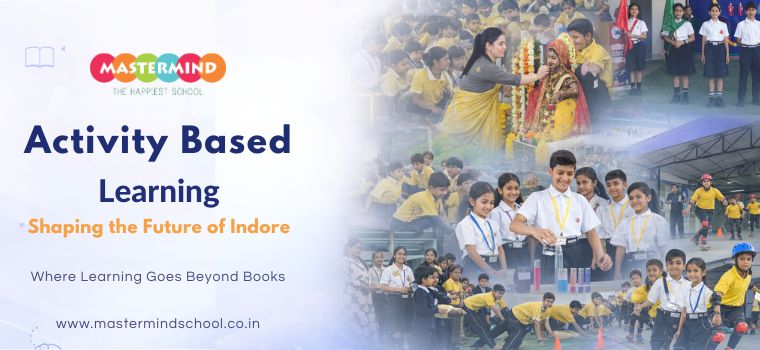
In the heart of Indore—a city rapidly becoming a global benchmark for cleanliness and urban growth—the way we educate our children is undergoing a profound revolution. Parents today are no longer satisfied with traditional "rote learning" where students simply memorize facts to pass an exam. Instead, there is a growing demand for an education that prepares children for the complexities of the 21st century. At Mastermind School, recognized as "The Happiest School," we believe the answer lies in Activity Based Learning (ABL).
This transition is more than just a trend; it is a necessity. As we celebrate our official CBSE Affiliation (Affiliation No. 1031472), we are doubling down on our commitment to shaping a brighter, more practical future for every child in Indore. By moving beyond the four walls of the classroom and the static pages of a textbook, we are creating learners who are not just informed, but empowered. This blog explores why ABL is the gold standard for modern education and how we implement it daily at Mastermind High School and our Pre-Primary Campus.
What You Will Learn in This Blog
In this detailed exploration, we will cover: What ABL Is: How it differs from rote learning, and why NEP 2020 backs it. The VARK Model: Our approach to diverse learning styles. Abhivriddhi: How our annual exhibitions turn students into innovators. Sports and Martial Arts: Building grit through Handball and Kalarippayattu. Cultural and Linguistic Competitions: From Sanskrit Shlokas to English Storytelling. Learning Beyond Classrooms: The impact of field trips to Ujjaini, Eco Farms, and beyond. Holistic Wellness: Why 10 minutes of daily Yoga and regular health check-ups are non-negotiable. Real-World Projects: What a rainwater harvesting project taught our students.
What Is Activity Based Learning, and How Is It Different From Rote Learning?
Activity Based Learning is a way of teaching in which children understand a concept by doing something with it first. They build a model, run an experiment, act out a story or visit a place, and then talk or write about what they found. The textbook still matters. It comes after the experience instead of replacing it.
This is no longer just one school's preference. India's National Education Policy 2020 (para 4.6) says experiential learning will be adopted as standard teaching at every stage of school. That includes hands-on learning, arts-integrated and sports-integrated education, and story-telling.
CBSE board papers have also moved steadily towards competency-based questions. These ask a child to apply a concept rather than repeat it, so understanding now matters more than memory. You can see how this works class by class on our CBSE curriculum and teaching page.
| What changes | Rote learning | Activity Based Learning |
|---|---|---|
| How a concept is met | Read, copied and memorised | Built, tested or experienced, then written down |
| The child's role | Listens and repeats | Asks, tries, and explains to others |
| Fractions, for example | Learn the rule by heart | Cut and share paper strips in the Math Lab, then write the rule |
| Mistakes | Cost marks, so children avoid trying | Part of the process, discussed openly |
| What "knowing it" means | Can repeat the answer | Can apply it to a new question |
| Exam questions it suits | Direct, textbook-style questions | Application and case-based questions, as well as direct ones |
Underneath every row is the same idea: a child who is not afraid of being wrong will try, ask and try again. That belief sits at the heart of our "I Can" approach to raising independent children.
The VARK Teaching Model: One Classroom, Many Styles
At Mastermind School, we recognize that every child is unique and "learns differently". To ensure no child is left behind, our curriculum is built on the VARK teaching model, which supports four distinct types of learners.
Visual Learners
These students grasp concepts best through pictures, videos, and diagrams.
Auditory Learners
They excel through listening, discussions, and the art of storytelling.
Reading/Writing Learners
These students prefer organized notes and written work to process information.
Kinesthetic Learners
These are the "doers" who understand the world through hands-on activities, role-plays, and live experiments. By designing our classrooms to include all these styles, we ensure that every child—whether in Play Group or Class 10—feels "included, engaged, and confident".
1. Abhivriddhi: The Ultimate Showcase of Practical Knowledge
One of the most significant events in our academic calendar is Abhivriddhi, our Annual Exhibition. Unlike a traditional test, Abhivriddhi requires students from Class 1 to 10 to create creative and subject-based projects across Science, Maths, Languages, EVS, Robotics, and Art.
How Kids Learn Through This
Students don't just "make" a model; they must "confidently present" their work to parents and visitors. For example, in our KG-II Abhivriddhi sessions, young learners take the stage to display their reading, storytelling, and Maths skills. This process transforms them from students into "subject matter experts." It builds public speaking skills, logical reasoning, and the ability to explain complex ideas—a skill they will need throughout their careers in Indore's competitive professional world.
2. Linguistic Excellence through Competitions
Language is the "door that opens worldwide success". At Mastermind, we prioritize spoken English and cultural traditions through regular competitions. Our recent English Story Telling and Poem Recitation events for various grades were specifically designed to enhance communication skills and imagination.
How Kids Learn Through This
Confidence: Standing on stage to recite a poem with "impeccable pronunciation and rhythmic expressions" helps students overcome stage fright.
Cultural Roots: Our Shloka Competition invites little ones to chant Sanskrit traditions, building a bridge between modern education and ancient wisdom. This dual focus ensures that our students are globally competitive yet deeply rooted in their values.
3. Physical Grit: Handball and Kalarippayattu
Activity Based Learning is not limited to academics; it extends to the sports field where "leaders are made". Our students recently made us proud in the Inter-School Kalarippayattu Championship, winning 7 Gold, 3 Silver, and 2 Bronze medals under expert coaching. Similarly, our action-packed Handball Tournaments for both girls and boys promote physical fitness and teamwork.
How Kids Learn Through This
Sports teach "discipline and grit". When a child practices Kalarippayattu, they aren't just learning self-defense; they are learning body coordination, mental focus, and respect for tradition. On the handball court, they learn "exceptional teamwork and sportsmanship," understanding that victory is a collective effort.
4. Field Trips: The World as a Classroom
We believe that some of the best lessons are learned "beyond textbooks". Our students frequently embark on field trips that turn Indore and its surroundings into a living laboratory.
Ujjaini Picnic
Students of Mastermind High School explored cultural sites, strengthening student-teacher bonding while learning history firsthand.
Pagdandi Eco Farms
Our KG-I learners observed exotic animals in their natural settings, encouraging a love for nature.
Simcha Amusement Park & The Zoo
These trips for our youngest learners in KG-II and Nursery focus on "sensory learning" and social interaction.
How Kids Learn Through This
Field trips provide "close-to-nature learning". When a child sees an animal or a historical site in person, the "curiosity and sensory learning" triggered are far more effective than looking at a picture in a book. It makes the curriculum "joyful and memorable".
5. Holistic Health and Spiritual Balance
A healthy mind resides in a healthy body. This is why Mastermind School integrates Yoga and Pranayam into the daily routine. Just 10 minutes of practices like Anulom Vilom and Deep Breathing help our students stay "balanced and disciplined". Furthermore, our Health Week and Dental Check-up Camps ensure that our learners are physically fit to handle academic challenges.
How Kids Learn Through This
These initiatives teach children the value of "preventive health" and self-care. By making health check-ups "child-friendly," we remove the fear often associated with doctors, teaching children to be proactive about their well-being.
6. Rainwater Harvesting: When a Local Problem Becomes the Lesson
Activity Based Learning works best when the problem is real. One of Mastermind School's earliest projects began with a difficulty every family in the area recognised: the nearby wells had dried up, and drinking water came only from a limited supply of tankers.
Instead of teaching water conservation only from a chapter, the school introduced students to rainwater harvesting. The children learnt how rainwater can be collected, stored and used to recharge the ground, and then carried that awareness home to their families and neighbours.
How Kids Learn Through This
A child who has seen a tanker queue understands why water matters far better than one who has only read the word "conservation". Projects like this connect Science and EVS to the child's own street, and show children that what they learn can change something around them. In Indore, where most of the year's rain falls in the June-to-September monsoon, it is also one of the most practical lessons a child can carry into adult life.
Why Mastermind School is the Right Choice for Your Child
As the Principals of Mastermind High School and the Pre-Primary Campus often emphasize, our goal is to provide a "warm, engaging environment where learning goes beyond classrooms". We don't just teach—we "make learning work for every child".
From our Vasant Panchami to our Vidya Aarambh celebrations, every event is "thoughtfully curated" to nurture confidence, creativity, and values. Our recent CBSE affiliation is a testament to our academic rigor, but our "Happiest School" title is what truly defines the spirit of our students.
Tips for Parents to Support ABL at Home
Learning is a partnership between school and home. To keep the momentum of Activity Based Learning going:
Encourage Spoken English
Small daily conversations in English with family will "greatly boost your child's confidence".
Daily Yoga
Encourage just 10 minutes of Deep Breathing every day—it's a "small habit for a big difference".
Discuss the "Why"
When your child returns from a field trip or an exhibition like Abhivriddhi, ask them to explain what they saw. This reinforces their "Auditory Learning".
For more everyday ideas, read our guide on how to support your child's learning at home.
Key Takeaways
- Activity Based Learning teaches a concept through doing first (models, experiments, stories, field trips) and through the textbook afterwards.
- NEP 2020 makes experiential learning standard at every stage, and CBSE papers increasingly reward applying a concept over repeating it.
- Mastermind uses the VARK model so each lesson reaches children through more than one mode.
- Abhivriddhi, competitions, sports such as Kalarippayattu and handball, and field trips carry learning beyond the classroom.
- Real problems teach best: a rainwater harvesting project turned a local water shortage into a lesson students took home.
- At home, the simplest support costs nothing: talk in English, practise deep breathing, and ask your child to explain the "why".
Frequently Asked Questions
What is activity based learning in simple words?
Activity based learning means children learn by doing. Instead of memorising a definition, a child builds a model, runs a small experiment, plays a role or visits a place, and then explains what they discovered. The teacher guides the activity and links it back to the textbook, so the child understands the concept before writing it down.
Is activity based learning only for pre-primary children?
No. It is often linked with play schools, but NEP 2020 asks for experiential learning at every stage of school. At Mastermind School it runs from Play Group through Class 10. The early years use play and Montessori-based work, and the higher classes use Science, Math, English, Computer and Robotics labs along with project work.
Will activity based learning prepare my child for CBSE board exams?
Board papers now include many competency-based questions that test whether a child can apply a concept, and children who have built and tested ideas tend to handle these with more confidence. Activities do not replace practice: Classes 9 and 10 at Mastermind follow the full board pattern. The school's first Class 10 batch sits the CBSE board exams in March 2027.
Does activity based learning mean less studying or less homework?
It does not mean less learning; it changes the order of learning. The activity comes first and the reading, writing and practice follow, so the written work makes sense to the child. Homework at Mastermind is kept age-appropriate and is designed to reinforce what was done in class, rather than repeat the lesson in a longer form.
How is activity based learning different from Montessori?
Montessori is one specific method, with its own prepared materials and a strong focus on self-directed work in the early years. Activity based learning is a broader umbrella covering many hands-on approaches, from experiments and models to role-play, projects and field trips. At Mastermind, Montessori-based learning is used in the foundational years, within the wider activity-based approach.
What is the VARK model, and does it really work?
VARK, developed by New Zealand educator Neil Fleming, describes four ways people take in information: Visual, Aural, Read/Write and Kinesthetic. Research has not shown that teaching a child only in one "preferred" style improves results. Its practical value lies in planning every lesson to use several modes, so each child gets more than one way into the same idea.
Is activity based learning suitable for a shy child or one who struggles in class?
Often it helps these children most. A child who finds a page of text hard may grasp the same idea through their hands or a story. Small-group activities also give quieter children a lower-stakes way to speak up. A good teacher still watches closely and adapts the activity when a child is falling behind, rather than moving on without them.
What is Abhivriddhi at Mastermind School?
Abhivriddhi is the school's annual exhibition. Students from Class 1 to 10 prepare subject-based projects in Science, Maths, Languages, EVS, Robotics and Art, and present them to parents and visitors. KG-II children take part with their own reading, storytelling and number activities. The aim is not just a finished model, but a child who can explain it confidently.
Which activities are part of the regular school day at Mastermind?
Abacus, Vedic Maths, Coding & AI, Robotics, Olympiad preparation, Yoga, Chess, Speech & Drama, sports, dance and art are built into the Mastermind timetable rather than offered as separate after-school courses. They are introduced at different stages, with Abacus and Coding starting in the primary years and Vedic Maths and Robotics stretching children in the middle years.
How can I support activity based learning at home without buying kits?
Use what is already in the house. Measure ingredients together while cooking, sort coins to practise counting, grow a plant and record its height each week, or ask your child to teach you something from school. The most useful habit costs nothing: after any outing or exhibition, ask "why" and "how" and let your child do the explaining.
Does the Mastermind School bus come to Pipliyahana?
Yes. Pipliyahana is part of the school bus network, which covers several areas of East Indore. Pickup points are set route by route, so contact the school to find the stop nearest your home. Buses are GPS-tracked and carry a female staff member; the full system is explained on the Safety & Transport page.
Where are Mastermind School's campuses?
Mastermind School has two campuses. The Pre-Primary Campus, for Play Group to KG-II, is at CA 6, Shreeji Valley, Bicholi Mardana, Indore 452016. Mastermind High School, for Class 1 to 10, is near Pitambara Dhaam Mandir, Dudhia, Indore. Both campuses follow the same activity-based, child-centric approach to learning.
Conclusion
Activity Based Learning is not just an educational method; it is a philosophy that respects the individuality of every child. In Indore, where the future is being built today, Mastermind School is proud to be at the forefront of this movement. We aren't just preparing students for their Annual Exams in March; we are preparing them for a lifetime of success, leadership, and happiness.
Visit the Campus
Activity Based Learning is easier to judge in person than on a page. Walk through the labs and classrooms your child would use, and ask a teacher how they would teach a topic your child finds difficult.
Book a campus visit or contact the school to speak with our team.
Author – Mr. Naveen Chowdhari
Naveen Chowdhari is a visionary educationist dedicated to redefining the academic landscape in Indore. As the Director of Mastermind School and Mastermind Abacus, he is a firm believer that premium, world-class education should be accessible to every aspiring student. Under his leadership, Mastermind School has become a benchmark for excellence—integrating advanced CBSE pedagogy, Robotics, and Smart-Class technology while maintaining a student-first approach to value. His mission is to empower the next generation of Indore with global skills and traditional roots.
Last Updated: 03 October 2026