
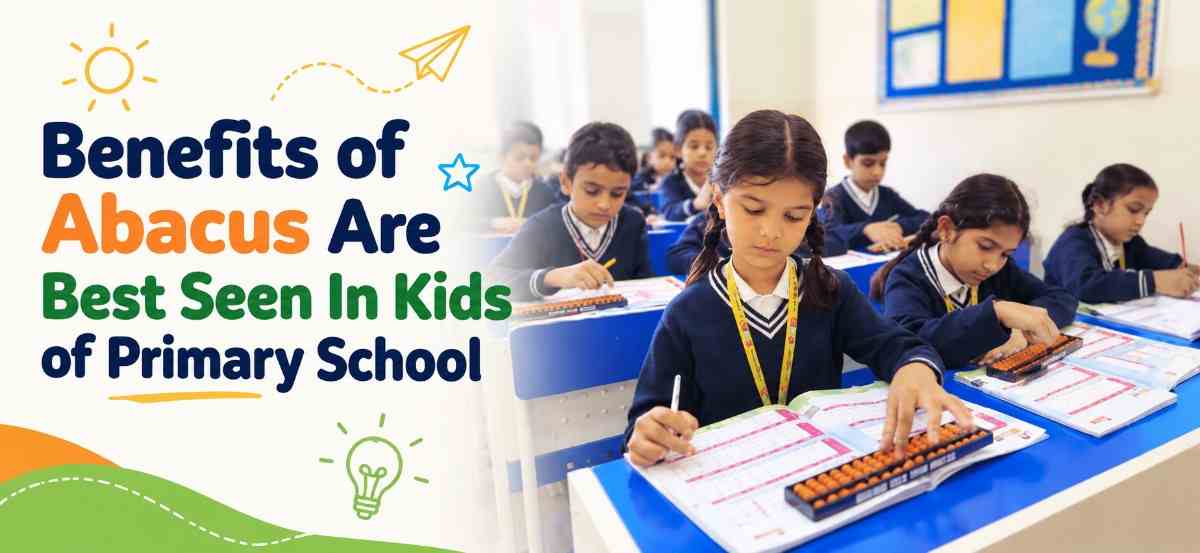
The main benefit of abacus for primary school children is faster and more accurate arithmetic. Moving beads gives a child a picture of every number, and with regular practice many children learn to calculate by imagining those beads. Abacus practice also demands steady attention. It does not raise IQ or guarantee marks, so it helps to know what to expect.
Many parents in Indore notice the same pattern between Class 1 and Class 5. The child understands the sum, yet loses marks to small slips in carrying and borrowing. Some children start saying "I am not good at maths" before they have really begun.
Abacus is one of the tools that can help at this stage. This guide explains what it is, which benefits hold up, which popular claims do not, and why it works best when it sits inside the school timetable.
What is an abacus and how do children learn it?
An abacus is a frame with beads that slide on rods. Each rod stands for a place value: ones, tens, hundreds and so on. It has been used for calculation for centuries, long before calculators existed.
Children learn it in stages. First they move real beads to add and subtract. Then they begin to picture the beads in their mind and move them in imagination. This second stage is called mental abacus, and it is where the speed in mental maths comes from.
What are the benefits of abacus for primary school children?
Calculation skills
You may have seen your child struggle with mental maths, or lose marks in an exam because of silly mistakes in a numerical problem. Abacus gives the child a way to see the calculation instead of only remembering a rule. With practice, this builds both speed and accuracy in addition, subtraction, multiplication and division.
Concentration
The abacus makes learning attractive for young children because it works through beads, numbers and movement. Moving the beads to solve a sum keeps the child's attention on that sum. One wrong bead changes the answer, so the child learns to slow down and stay with the task.
This habit of sitting with one problem until it is finished is useful in every subject, not only in maths. It is a habit built by practice, though, not something that appears after a few classes.
Visualisation and memory
In mental abacus the child holds a picture of the beads in mind and updates it step by step. This is practice in visualising and in holding information for a short time. Children who enjoy it often become more comfortable handling longer sums in their head.
Confidence with numbers
For many children the biggest change is in attitude. A child who can work out an answer quickly and check it independently stops fearing the maths period. That confidence often matters more than the speed itself, because a child who is not afraid of numbers keeps trying.
What does the research say about abacus training?
The strongest study on this topic was done in India. In a three-year randomised controlled trial published in the journal Child Development, 204 children who were 5 to 7 years old at the start were followed through their early school years. The children who learned mental abacus did better on arithmetic than children who spent the same time on extra standard maths.
The same study looked for changes in basic mental abilities such as working memory. It did not find clear evidence that abacus training improved them. The gain was in arithmetic.
A later one-year classroom trial by the same research group adds a useful caution. After a year of weekly lessons, first-graders still struggled to use the abacus well, while second-graders managed better. Abacus needs time and regular practice before results show.
Does abacus make children more intelligent?
You will often read that abacus develops the right side of the brain, raises IQ or teaches multitasking. These claims go further than the evidence. The idea that school subjects train the "left brain" and abacus trains the "right brain" is a popular simplification, and there is no reliable proof that abacus raises a child's IQ.
What can be said honestly is narrower, and still worth having. The table below separates the two.
| What you may hear | What parents can fairly expect |
|---|---|
| Abacus makes children good at maths | It improves arithmetic speed and accuracy. Concepts, word problems and geometry still need regular maths teaching. |
| Abacus increases IQ | Not proven. Treat it as a maths skill, not an intelligence booster. |
| Abacus develops the right brain | It gives practice in visualising numbers. The left brain and right brain split is a simplification. |
| Results come in a few weeks | Expect months of steady practice, and longer for the youngest children. |
| Abacus improves concentration | Each session is focused practice. The habit grows when practice is regular. |
| Every child will become a human calculator | Children progress at different speeds. Comfort with numbers is the realistic goal. |
Why is primary school the right time to start?
Between Class 1 and Class 5 a child is forming number sense: place value, carrying, borrowing and tables. The abacus shows exactly these ideas in a physical form. A child who has pushed ten beads across and exchanged them for one bead on the next rod understands carrying in a way a rule cannot teach.
Young children also learn well through their hands. That is why the abacus fits the primary years better than later classes, when maths moves towards algebra and abstract reasoning. Starting early also gives the child enough years to reach the mental stage without hurry.
Should abacus be part of the school timetable or a separate class?
Many families in Indore send children to an abacus class after school. It can work, but it adds travel, another fee and one more commitment to an already full evening. When the bypass traffic is heavy or the monsoon sets in, the outside class is usually the first thing to be missed.
Abacus inside the school timetable solves most of this:
- Regular practice. The period happens every week through the session, which is what the skill needs.
- Every child takes part. It is not limited to families who can manage an extra class.
- One teaching team. Abacus practice and the maths period can support each other instead of pulling in different directions.
- Free evenings. The child has time for play, reading and rest.
How is abacus taught at Mastermind School?
At Mastermind High School (Class 1–10), near Pitambara Dhaam Mandir, Dudhia, abacus is one of the skill activities built into the regular timetable. It is not offered as a separate add-on course. It begins in the primary classes, where children practise age-appropriate mental arithmetic to build speed, accuracy and focus over time.
Abacus sits alongside Vedic Maths, a hands-on Math Lab and the CBSE curriculum and teaching approach the school follows. The same thinking runs through other activities, which you can read about in our blogs on robotics in primary school and activity-based learning. Details of what the school year includes are on the school fees page.
How can parents support abacus practice at home?
- Keep practice short. Ten minutes a day works better than one long session on Sunday.
- Ask your child to teach you one sum. Explaining it strengthens the skill.
- Praise accuracy before speed. Speed follows on its own.
- Do not compare your child's level with another child's.
- Use everyday numbers, such as the vegetable bill or cricket scores, for quick mental sums.
For more ideas, see our guide on how to support your child's learning at home.
Key Takeaways
- The best-supported benefit of abacus is faster, more accurate arithmetic.
- Abacus practice also builds focus and confidence with numbers.
- There is no reliable proof that abacus raises IQ, so treat such claims with care.
- The primary years, Class 1 to 5, suit abacus well because number sense is forming.
- Results need months of regular practice, not weeks.
- Abacus inside the school timetable gives consistency without extra evening classes.
Frequently Asked Questions
What is the right age to start abacus?
Most children are ready in the early primary years, once they can count confidently and recognise numbers. Research on school abacus programmes has mostly involved children starting at 5 to 7 years. Very young children may take longer to become comfortable with the tool, so patience matters more than an early start.
Does abacus really improve maths marks?
Abacus improves arithmetic speed and accuracy, which reduces calculation mistakes in exams. It does not replace an understanding of concepts, word problems or geometry. A child who calculates well but does not understand the question will still lose marks, so abacus works best alongside good classroom teaching in maths.
Does abacus increase IQ or brain power?
There is no reliable evidence that abacus raises IQ. A three-year trial with primary children found clear gains in arithmetic but no clear change in abilities such as working memory. It is better to see abacus as a strong maths skill that also gives practice in focus and visualisation.
How long does it take to see results from abacus?
Expect a few months before your child is comfortable with the beads, and longer before mental calculation becomes quick. In one classroom study, first-graders were still struggling after a year of weekly lessons while second-graders did better. Regular, short practice makes more difference than the number of months.
Will abacus confuse my child with the methods taught in maths class?
It usually does not, because the abacus is built on the same place value system used in school maths. Carrying and borrowing on the beads match what the child writes in the notebook. Some children mix methods in the first weeks, and this settles as both become familiar.
What is the difference between abacus and Vedic Maths?
Abacus is a bead tool that builds number sense and mental calculation from the early primary years. Vedic Maths is a set of shortcut methods for faster calculation, which suits children who already know their tables and basic operations. Many schools introduce abacus first and Vedic Maths a little later.
Is my child in Class 4 or 5 too late to start abacus?
No. Older primary children often pick up the bead movements faster because they already understand place value. They may have fewer years to reach advanced mental levels, but the gains in accuracy, speed and confidence with numbers are still worthwhile at this age.
Is abacus part of the timetable at Mastermind School, Indore?
Yes. At Mastermind High School, abacus is one of the co-curricular skills built into the school timetable, beginning in the primary classes. It is taught during school hours and is not run as a separate add-on course. You can ask the school which classes have abacus periods in the current session.
Does the Mastermind School bus cover Pipliyahana and Kanadia?
Yes, the school bus network covers both areas along with several other parts of East Indore. Buses are GPS-tracked and have a female staff member on board. For the pickup point nearest your home, see the safety and transport page or contact the school.
Conclusion
Abacus is worth your child's time for a simple reason: it makes arithmetic quicker, more accurate and less frightening. That is a real advantage in the primary years, when a child's attitude to maths is being decided.
It is not a shortcut to intelligence, and it needs regular practice over a long period. A school that gives it a fixed place in the week, and keeps its promises modest, is giving children the conditions in which abacus actually works.
Visit the Campus
The best way to judge an abacus programme is to watch children using it. Visit Mastermind High School, see a class in progress and ask the teachers how abacus fits into the week.
Book a campus visit or contact the school to speak with our team.
Author – Mr. Naveen Chowdhari
Naveen Chowdhari is a visionary educationist dedicated to redefining the academic landscape in Indore. As the Director of Mastermind School and Mastermind Abacus, he is a firm believer that premium, world-class education should be accessible to every aspiring student. Under his leadership, Mastermind School has become a benchmark for excellence—integrating advanced CBSE pedagogy, Robotics, and Smart-Class technology while maintaining a student-first approach to value. His mission is to empower the next generation of Indore with global skills and traditional roots.
Last Updated: 05 October 2026