
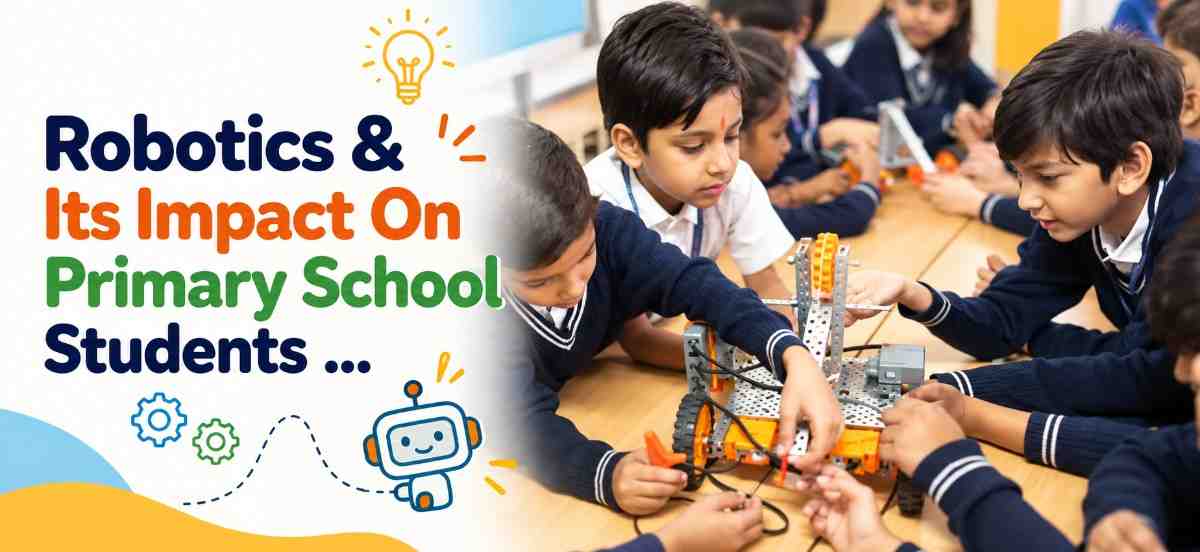
Robotics helps primary school students learn by building. When a child assembles a simple machine and makes it move, they practise problem-solving, creativity, concentration and teamwork at the same time. These skills support every subject, not just science. At this age no coding is needed: children begin with hands-on, codeless kits and move to programming later.
In Indore, weekend robotics and coding classes are now advertised by coaching centres across the city, and many parents wonder whether their child is missing out. The more useful question is what a young child actually gains from robotics, and whether it needs to be an extra class at all.
This guide explains what robotics means in the primary years, the seven skills it builds, what it should look like at each age, and how to judge a school's robotics programme when you visit.
What does robotics mean for a primary school child?
For a young child, robotics is not about building a humanoid machine. It means putting parts together, such as wheels, gears, levers and motors, so that something moves or does a small job. The child then changes the design until it works better.
The learning is in the trying. A model that falls over or refuses to move teaches more than one that works the first time, because the child has to find out why.
What is codeless robotics?
Codeless robotics is robotics without a screen or typed code. Children in the pre-primary years explore balance, gears and simple models with their hands. They learn cause and effect ("if I add this wheel, it rolls") long before they can read an instruction on a screen.
This is the right starting point for the youngest children. Programming comes later, usually by arranging picture blocks, once the child already understands how the machine behaves.
How does robotics help primary school students?
1. Problem-solving skills
Students are given a small task to make their robot perform: move forward, lift an arm, stop at a line. They have to work out how to do it, try it, and fix what does not work. Nobody hands them the answer, so every finished task is a problem they solved on their own.
2. Innovation
Robotics is undoubtedly a field of innovation. Apart from the set tasks, students can use what they have learnt to add ideas of their own: a new movement, a different design, a job the robot was never meant to do.
3. Creativity
The skill that gives rise to the innovative side is creativity. Two children given the same kit rarely build the same model, and a good teacher asks each of them to explain why theirs is different.
4. Up-to-date technical skills
The world doesn't stand still; new technology arrives every other day. Learning robotics at a young age helps children adapt to these changes, learn them as they occur, and perhaps even pioneer a change of their own.
5. Communication skills
Robots require commands to perform, and a command has to be clear. Children learn to give exact, step-by-step instructions. They also present what they have built to classmates and parents, and a child who can explain how a machine works is practising confident speaking.
6. Concentration
A robot will not work if one gear is out of place or one step is missed, so children learn to slow down and stay with a task. Robotics also gives quieter children a place to shine. A child who hesitates to speak in front of the class is often the one who patiently gets the model working.
7. Teamwork
The most important part of building a robot together is teamwork. When students from different backgrounds come together to make their mechanical friend work, they learn to share parts, divide roles, adapt and adjust.
What should robotics look like at each age?
Robotics is useful only when it matches the child's age. A five-year-old and a twelve-year-old should not be doing the same thing. The table below shows a sensible progression, and how it is arranged at Mastermind School.
| Stage | What suits this age | At Mastermind School |
|---|---|---|
| Play Group to KG-II | Codeless building: balance, gears, simple models. No screen, no typing. | Codeless robotics at the Pre-Primary Campus |
| Class 1 to 5 | Simple working models and first step-by-step instructions, taught as play. | Coding & AI begin early, with hands-on work in the labs |
| Class 6 to 8 | Building and programming working robots, usually in small teams. | Robotics in the Robotics Lab, alongside Olympiad preparation |
| Class 9 to 10 | Applying the same logic to science and maths practical work. | Board-pattern learning with lab practicals and CBSE skill subjects |
Is robotics now part of the CBSE curriculum?
From the 2026–27 session, CBSE has introduced a Computational Thinking and Artificial Intelligence curriculum for Classes 3 to 8. The emphasis is on thinking skills, such as spotting patterns, breaking a problem into steps and putting instructions in order, rather than on a separate robotics exam.
These are exactly the habits a child practises while building a robot. So a school that already teaches robotics and coding inside the day is not adding a hobby; it is giving children a practical route into what the board now expects. You can read how this fits into daily teaching on our CBSE curriculum page.
How can you judge a school's robotics programme?
Almost every school brochure now mentions robotics. These five questions, asked on a campus visit, tell you what is really on offer:
- Is it inside the timetable? A period in the school day reaches every child. An after-school club reaches only a few.
- Does every child handle a kit? Watching a teacher's demonstration is not robotics. Ask how many children share one kit.
- Is there a separate charge? Ask whether robotics is covered by the school fee or billed as an add-on.
- Is it matched to age? The youngest children should be building with their hands, not sitting at a screen.
- Does the lab look used? Half-built models, labelled boxes and children's work on display say more than a spotless room.
How can parents support this at home?
You do not need to buy an expensive kit. What matters is keeping your child's curiosity about how things work alive.
- Let your child build freely with blocks, cardboard or old boxes, and ask what the model does.
- When a toy breaks, open it together and look at what is inside before throwing it away.
- Ask "how do you think this works?" about everyday things: a fan, a door lock, a bicycle chain.
Robotics at Mastermind School
At Mastermind School, robotics is part of the regular school day rather than a separate paid class. Robotics, Coding & AI and Abacus all sit inside the timetable, and the cost is covered by the regular school fee. The full class-wise structure is published on the school fees page.
Children at the Pre-Primary Campus in Bicholi Mardana (Play Group to KG-II) start with codeless robotics, exploring balance, gears and simple models with their own hands.
At Mastermind High School in Dudhia, Coding & AI begin in the primary years, and students use the kits and tools in a dedicated Robotics Lab to build and program working robots. It is one of five working labs on the campus, along with Science, Maths, English and Computer.
Robotics is one part of a wider approach. You can read more about activity-based learning and about how abacus benefits your child's growth, which runs alongside it.
Key Takeaways
- Robotics teaches young children to solve problems by building, testing and fixing.
- It builds seven skills: problem-solving, innovation, creativity, technical confidence, communication, concentration and teamwork.
- The youngest children should start with codeless robotics, with no screen and no typing.
- CBSE has introduced a Computational Thinking and AI curriculum for Classes 3 to 8 from 2026–27.
- Check whether a school teaches robotics inside the timetable and whether every child handles a kit.
- At Mastermind School, robotics is part of the regular programme and covered by the school fee.
Frequently Asked Questions
What is the right age to start robotics?
Children can start as early as the pre-primary years, as long as the activity matches their age. For two- to five-year-olds that means codeless robotics: building, balancing and exploring with their hands. Simple block-based programming usually suits the primary classes, and more detailed building and coding fits the middle school years.
What is codeless robotics?
Codeless robotics is robotics without a screen or typed code. Young children work with physical kits, using gears, wheels, levers and building pieces to make models and see how things move. It teaches cause and effect, sequencing and problem-solving through play, and prepares children for programming when they are older.
Does my child need to know coding before starting robotics?
No. Robotics is often the easiest way into coding, not the other way round. Children first build something physical and then learn to give it instructions, usually by arranging picture blocks rather than typing. Because they can see the robot respond, the logic of coding makes sense much faster.
What is the difference between coding and robotics?
Coding is writing instructions for a computer. Robotics combines those instructions with a physical machine that the child designs and builds. In coding, the result appears on a screen; in robotics, something actually moves on the table. Many schools teach both together, because each one makes the other easier to understand.
Will robotics increase my child's screen time?
Not by much, if it is taught well. Most of a robotics period is spent off-screen, sorting parts, building, testing and fixing. A screen is needed only when children program the model, and at the pre-primary level codeless robotics uses no screen at all. Ask the school how a typical period is divided.
Is robotics part of the CBSE curriculum?
From the 2026–27 session, CBSE has introduced a Computational Thinking and Artificial Intelligence curriculum for Classes 3 to 8. It focuses on logical thinking and problem-solving rather than a separate robotics exam. Robotics is one of the practical, hands-on ways a school can build these same skills in the classroom.
Will robotics take time away from regular studies?
It should not, when robotics is part of the school timetable instead of an extra evening class. A robotics period also supports core subjects: children measure, count, estimate and reason while they build, which is maths and science in practice. The concern is more real when it adds another class to an already full week.
Is robotics only for children who are good at maths?
No. Robotics rewards patience, curiosity and teamwork as much as calculation. Children who enjoy drawing often design the best models, and quieter children frequently do well because the work is hands-on. The aim in primary school is not to produce engineers, but confident children who are not afraid of a new problem.
Does Mastermind School charge separately for robotics?
No separate charge is taken for robotics at Mastermind School. Robotics, Coding & AI and Abacus are taught inside the regular timetable and are covered by the school fee. The complete class-wise structure, from Play Group to Class 10, is published on the school fees page, so parents can check it before visiting.
Is there a CBSE school with a robotics lab near Kanadia?
Mastermind High School, near Pitambara Dhaam Mandir in Dudhia, has a Robotics Lab on campus, and the school bus network covers Kanadia. For the pickup point nearest to your home and the current route, contact the school office. Details of the bus safety system are on the Safety & Transport page.
Conclusion
The students of this generation are lucky enough to explore robotics from a young age. What they take away is not a finished robot but a habit: look at a problem, try something, see what happens, and try again.
That habit serves a child in every subject and long after school. The best way to know whether a school is building it is to walk into the lab and watch the children at work.
Visit the Campus
See the Robotics Lab for yourself and watch how children build and test their own models. Our teachers will be glad to show you what a robotics period looks like for your child's class.
Book a campus visit or contact the school to speak with our team.
Author – Mr. Naveen Chowdhari
Naveen Chowdhari is a visionary educationist dedicated to redefining the academic landscape in Indore. As the Director of Mastermind School and Mastermind Abacus, he is a firm believer that premium, world-class education should be accessible to every aspiring student. Under his leadership, Mastermind School has become a benchmark for excellence—integrating advanced CBSE pedagogy, Robotics, and Smart-Class technology while maintaining a student-first approach to value. His mission is to empower the next generation of Indore with global skills and traditional roots.
Last Updated: 05 October 2026