
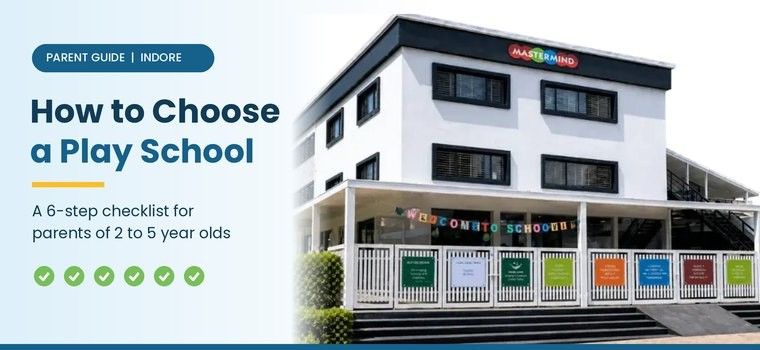
To choose a play school in Indore, shortlist three or four schools close to your home, visit each one while classes are running, and compare them on the same six points: your child's needs, the classrooms, safety, the teachers, what other parents say, and the full cost. For a 2 to 5 year old, a calm, clean, well-staffed school nearby usually works better than a large campus far away.
Selecting a play school in Indore is one of the first big decisions you make for your child, and it is easy to be swayed by a brochure or a building. So before you compare schools, it helps to be clear about what these early years are for.
When looking for a school, it is crucial to understand what you should expect from it. You should expect little academic learning when talking about a pre-primary school or a play school. Instead, you should be expecting a lot of grooming to happen.
Play schools are where your child will be cared for by people trained for the purpose. Most importantly, a play school should be able to take care of the anxiety of separation a child is likely to face on being away from home for the first time.
6 Essential Steps for Selecting a Play School
1. Make a List
As the first step, list all the nearby schools. You could use the internet's help, your neighbours, relatives, friends, and parents having school-going children. You will get reasonably good information, which you can filter in the next step.
Keep the list close to home. A long ride across the bypass twice a day is tiring for a three-year-old, and it gets harder in the monsoon. If you live around Pipliyahana or Kanadia, for example, check whether the school's bus actually comes to your lane before you fall in love with the campus.
2. Know Your Child
As parents, you know your child and their needs better than anyone else. Some children settle quickly and need very little guidance. Others do better when they are given a structured routine. And some children need special attention.
Write down two or three things that matter for your child in particular: speech, toilet training, afternoon naps, shyness with strangers, food habits. Ask every school on your list the same question: "How would you handle this?" The answers will tell you more than the brochure.
3. Visit the School
Despite all the information from various sources, a personal visit always gives a better picture. Go while classes are running, and observe everything diligently. See if the premises are clean and well maintained. Look at the size of the classrooms and the seating: is it comfortable, tidy, and are there interesting displays at a child's eye level?
The number of students per class is vital, because a crowded class means less attention per child. As a benchmark, the NCPCR Regulatory Guidelines for Private Play Schools ask for one teacher and one caregiver for every 20 children in the 3 to 6 age group. Ask each school for its actual numbers, and count the adults in the room yourself.
The bathrooms should be hygienic and sized for small children. And look at the play zone: is it good enough to keep your child engaged and happy?
4. Safety
This should be an essential concern: safety in every respect, in the classroom and outdoors. The toys in the classroom and the equipment in the play zone should be such that children cannot hurt themselves, and should be safe for their health.
Are visitors monitored and questioned before being allowed in, or can a stranger simply walk in? When children leave the premises, are they handed over to the parents, or transported under the supervision of responsible staff? Is there enough staff to watch the children while they run around in the play area or the ground?
If you want a longer list to carry with you, use these 15 safety questions every Indore parent should ask.
5. Talk to the Teachers, Parents and Principal
Talking with the right person always gives relevant information. During your visit, talk with the teachers and see if they communicate well and are empathetic and caring. Find out if they are well trained and experienced.
It is vital that the teachers are stable and do not change frequently. Small children take time to make emotional connections, and a new face every few months affects their behaviour. Also talk to the supporting staff, and see if they are friendly and caring towards the children.
Talk to the parents of children studying in the school. While the school staff might give you a rosy picture, the parents will tell you how things really are. If need be, visit on the day of a PTM.
Remember to talk to the Principal; a good principal has a significant impact on the entire functioning and environment of the school. Find out how much involvement the school expects from parents, what its homework policy is, and whether it organises field trips.
6. Fees and Other Costs
Once you have gathered the requisite information and are satisfied, find out the school fee and the other expenses involved. It should be affordable and compatible with the value being provided.
A large building is not, by itself, a reason to pay a hefty fee. What you are paying for is the care, grooming and education your child receives, and that depends far more on the teachers and support staff than on the infrastructure.
Ask for the complete break-up in writing: registration, admission, caution money, tuition, annual charges, transport, uniform and books, along with the instalment dates. A school that is confident about its pricing will share all of it without hesitation. As an example of a published break-up, see the Mastermind school fees page.
What Should You Check on a Play School Visit?
Carry this table with you. Use the same points at every school so that you are comparing like with like.
| What to check | What to look or ask for | Warning sign |
|---|---|---|
| Class size | Children per class, and how many adults are in the room | Vague answers, or one adult alone with a large group |
| Teachers | Training, experience, and how long they have been at the school | Teachers changing every few months |
| Classrooms | Clean, bright rooms with child-height furniture and displays | You are shown only the reception and the office |
| Washrooms | Child-sized, clean, with a helper present | Wet floors, bad smell, no adult nearby |
| Entry and pick-up | Visitors checked at the gate; a clear rule on who can collect a child | Anyone can walk in during school hours |
| Daily routine | A balance of play, rhymes, stories, movement and rest | Long hours of writing and worksheets for toddlers |
| Fees | Full written break-up with instalment dates | Figures given only verbally, or "other charges" left open |
How Does Mastermind Pre-Primary Fit This Checklist?
Mastermind School's Pre-Primary Campus is at CA 6, Shreeji Valley, Bicholi Mardana, and runs Play Group, Nursery, KG-I and KG-II for children from 2+ to 5+ years. The school day is 9:30 AM to 1:30 PM. Learning is built around the Montessori method, phonics, a reading programme and speech and drama, not heavy written work.
On safety, the campus has CCTV coverage and RFID attendance, and the school buses are GPS-tracked with a female staff member on board. The details are on the safety and transport page. After KG-II, children continue into Class 1 at Mastermind High School, so parents do not have to begin a second school search.
We would ask you to apply the same six steps to us as to any other school. Visit, watch a class, talk to the teachers and to parents at the gate, and then decide.
Key Takeaways
- Expect grooming, care and social learning from a play school, not heavy academics.
- Shortlist schools close to home; a long daily commute is hard on a small child.
- Always visit while classes are running, and see the classrooms, washrooms and play area yourself.
- Ask for the actual class size and count the adults in the room.
- Stable, caring teachers matter more than a large building.
- Talk to current parents as well as the school staff and the Principal.
- Get the complete fee break-up in writing before you decide.
Frequently Asked Questions
What is the right age to start play school in Indore?
Most play schools in Indore take children into Play Group from about 2 years, Nursery at 3+, KG-I at 4+ and KG-II at 5+. At Mastermind, age is counted as on 31st March and the session begins on 1st April; the details are on the admissions page. Your child's readiness to spend a few hours away from home matters as much as the birth date.
What is the difference between play school, nursery and kindergarten?
They are stages of the same pre-primary journey. Play Group is the soft first step for two-year-olds, built on play, rhymes and motor skills. Nursery introduces sounds, letters and pre-writing. KG-I and KG-II, the kindergarten years, build early reading and number skills and prepare a child for Class 1.
How many children should there be in a play school class?
There is no single number that suits every school, but the NCPCR Regulatory Guidelines for Private Play Schools ask for one teacher and one caregiver for every 20 children aged 3 to 6. For two-year-olds, look for smaller groups. Ask the school for its actual class strength and check it during your visit.
Is Montessori better than the play-way method?
Both are child-friendly and neither is "better" for every child. Montessori gives children hands-on materials and builds independence and concentration. Play-way teaches through games, songs and group activity. Many good schools combine the two. What matters more is how warmly and consistently the teachers apply the method in the classroom.
Should I choose a standalone play school or one attached to a bigger school?
A standalone play school can be perfectly good, but it ends after kindergarten and you will have to look for admission again at Class 1. A play school that is part of a larger school lets your child move up with familiar friends and routines. Check that the pre-primary section still has its own child-sized spaces and staff.
When should I start looking for a play school in Indore?
Since most CBSE-pattern schools in Indore begin the session in April, start a few months earlier so that you are not deciding in a hurry. That gives you time to visit three or four schools on working days, see real classes, speak to other parents, and compare the written fee details calmly.
What should I ask the teacher during a play school visit?
Ask how long she has taught at this school, how a crying child is settled in the first weeks, what a normal day looks like, how toilet needs and meals are handled, and how parents are kept informed. Notice how she speaks about children. A teacher who answers with specific examples usually knows her class well.
How much are play school fees in Indore?
Fees differ widely from school to school depending on location, facilities and hours, so compare the complete yearly cost and not only the tuition. Ask each school for one-time charges, tuition, annual charges, transport, uniform and books in writing. Mastermind publishes its full pre-primary fee structure openly on its website.
Is there school transport to Mastermind Pre-Primary from Pipliyahana or Kanadia?
Yes. The school's bus routes cover both areas along with several other parts of East Indore. Buses are GPS-tracked and have a female staff member on board. Pickup points are fixed route by route, so please contact the school to confirm the nearest stop to your home and its timing.
Can I visit Mastermind Pre-Primary before taking admission?
Yes, parents are welcome to visit the Pre-Primary Campus in Bicholi Mardana before deciding. Campus visit hours are Monday to Friday, 2:00 PM to 4:00 PM, and Saturday, 9:00 AM to 4:00 PM. You can bring your child along to see the classrooms, meet the teachers, and ask the questions from this checklist.
Conclusion
A play school is your child's first experience of the world outside home, so the right choice is the one where your child is safe, cared for, and happy to go back the next morning. A building or a brand name cannot tell you that. A visit, a few honest conversations and a written fee sheet can.
Lastly, conduct enough research before you settle on the most suitable school for your child. Use the six steps and the table above at every school on your list, and trust what you see with your own eyes.
Also Read: Benefits of Play School for Your Child
Visit the Campus
The simplest way to use this checklist is to walk through a play school with it in your hand. Come and see the Mastermind Pre-Primary classrooms, meet the teachers, and judge for yourself.
Book a campus visit or contact the school to speak with our team.
Author – Mr. Naveen Chowdhari
Naveen Chowdhari is a visionary educationist dedicated to redefining the academic landscape in Indore. As the Director of Mastermind School and Mastermind Abacus, he is a firm believer that premium, world-class education should be accessible to every aspiring student. Under his leadership, Mastermind School has become a benchmark for excellence—integrating advanced CBSE pedagogy, Robotics, and Smart-Class technology while maintaining a student-first approach to value. His mission is to empower the next generation of Indore with global skills and traditional roots.
Last Updated: 05 October 2026