
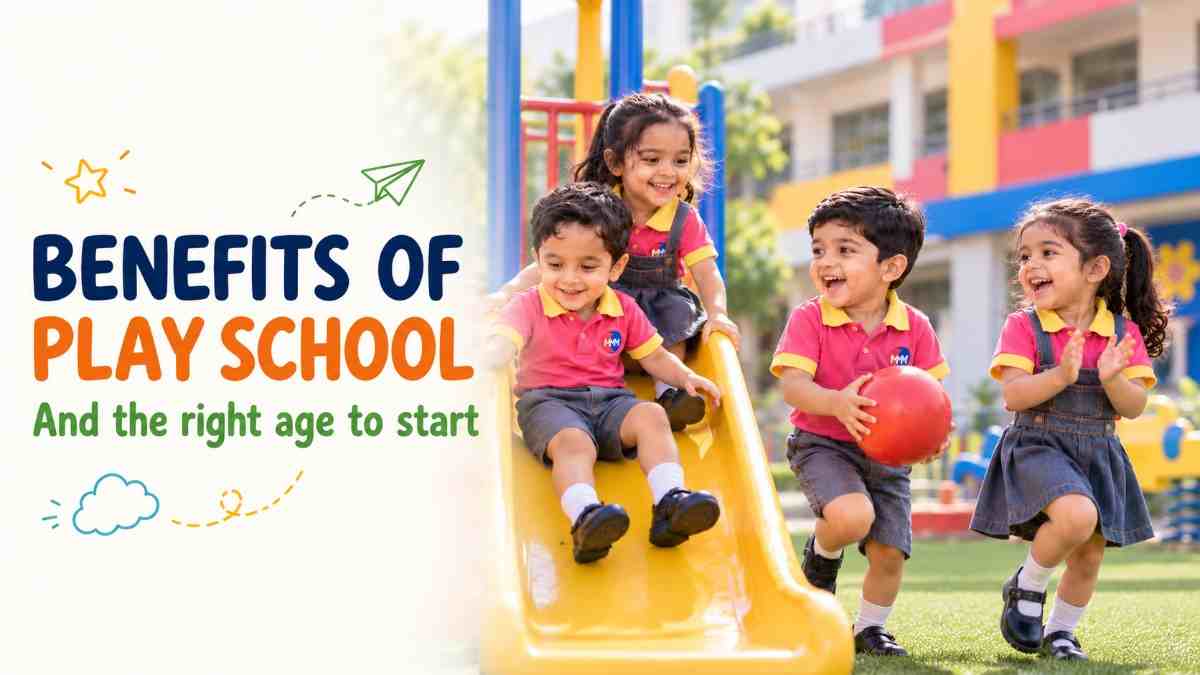
A good play school gives a young child four things that are hard to arrange at home: friends of the same age, space to move, a gentle daily routine, and trained adults who turn play into early language and number skills. Most children are ready for a short, play-based programme between the ages of 2 and 3, and structured pre-school learning begins at 3.
That is the short answer. The longer one matters, because "play school" can mean very different things from one gate to the next, and a two-year-old cannot tell you whether the place is good for them.
This guide explains what play school actually does for a child, what the right age is, how to tell whether your own child is ready, and what to check before you choose one in Indore.
Why do so many families in Indore choose a play school?
Walk through any newer colony along the bypass and you will find a play school every few lanes. That is not an accident. Family life in the city has changed, and play schools have grown to fill the gaps.
- Smaller families. Many young parents live away from grandparents, so there are fewer experienced hands and fewer cousins to play with.
- Both parents working. Parents want their child's morning hours to be safe, happy and well spent.
- Compact homes. Flats and row houses leave little room for a toddler to run, climb and tumble.
- Few safe play areas. Many townships have parking where a playground should be.
- Fewer children nearby. A child may go days without meeting another child of the same age.
None of this is a failing on the parents' part. It is simply how cities work now. The useful question is not why play schools exist, but whether the one you are considering actually fills these gaps for your child.
What are the real benefits of play school?
1. Friends of the same age
At home, adults adjust to the child. Among other two- and three-year-olds, nobody does. This is where children first learn to wait for a turn, share a toy, join a game and cope when a friend says no. These are skills, and they need practice with real children.
2. Faster language growth
Rhymes, stories, circle time and constant conversation surround a child with words. Children who hear and use more language in these years find reading and writing easier later. A shy child often begins to speak up simply because everyone around them is talking and singing.
3. Space to move
Running, climbing, balancing and dancing build the large muscles. Threading beads, pouring, colouring and working with clay build the small ones that will later hold a pencil. A child who has used up their energy also tends to eat and sleep better.
4. A gentle routine
Arriving, greeting, playing, eating, tidying up and going home in the same order each day makes a small child feel secure. Predictable days usually mean fewer meltdowns, at school and at home.
5. Small steps towards independence
Carrying their own bag, opening a tiffin, washing hands and putting toys back are big achievements at this age. Each one tells the child, "I can do this myself." That confidence carries into everything that follows.
6. An easier start to school
A child who is already comfortable with teachers, classrooms and a few hours away from home usually settles into Nursery and KG far more smoothly. If drop-offs are your main worry, our guide on overcoming separation anxiety on the first day of preschool covers it in detail.
7. A trained pair of eyes
A teacher who works with many children of the same age can notice when a child may need a little extra support with speech, hearing, movement or social play, and can tell parents early. That is much harder to judge at home with only one child to compare.
What is the right age to start play school?
India's National Education Policy 2020 notes that over 85% of a child's cumulative brain development happens before the age of 6. For that reason it places ages 3 to 8 in a single "Foundational Stage", built around play and activity rather than textbooks, with Class 1 beginning at age 6.
So structured early learning officially begins at 3. Play Group, for children who have turned 2, is an optional soft start before that. It is not an academic class, and no child is "behind" for skipping it.
| Stage | Age | What it is for |
|---|---|---|
| Play Group | 2+ years | Rhymes, free play, motor skills and learning to enjoy school |
| Nursery | 3+ years | First sounds and letters, pre-writing, circle time |
| KG-I | 4+ years | Early reading, number skills, speaking with confidence |
| KG-II | 5+ years | Reading fluency and readiness for Class 1 |
| Class 1 | 6+ years | Formal schooling begins |
These are the age bands Mastermind School follows, with age counted as on 31st March because the session starts on 1st April. Other schools may use a slightly different cut-off, so always check the date before you plan.
How do you know your child is ready?
Age is only a guide. Two children born in the same month can be ready six months apart. Readiness has nothing to do with knowing the alphabet. Look for these signs instead:
- Your child can stay with a familiar adult other than a parent for an hour or two.
- They show interest in other children, even if they only watch at first.
- They can tell you what they need, through words, gestures or pointing.
- They follow simple instructions such as "bring your shoes".
- They have a fairly regular pattern of sleeping and eating.
Consider waiting a few months if your child is unwell often at the moment, or if the family is going through a big change such as a new baby or a house move. Starting in the next term is not a setback.
When you do decide to start, a few weeks of preparation at home makes a real difference. See how to prepare your child for preschool for a step-by-step plan.
What should you look for in a play school?
Do not choose a play school because of its signboard or because it calls itself the best. Visit during working hours, watch the children, and check these points.
| What to check | What good looks like |
|---|---|
| Classrooms | Bright, airy and cheerful, with furniture at child height |
| Play space | Enough room to run and climb, with safe, well-kept equipment |
| Teachers | Trained in early-years teaching, calm, and down at the child's eye level |
| Class size | Small enough for the teacher to know every child by name and habit |
| Teaching method | Learning through play and hands-on activity, not worksheets and rote |
| Support staff | Gentle, trained helpers for meals and washroom needs |
| Safety | Controlled entry and exit, CCTV, and a clear handover process |
| Hygiene | Clean washrooms, clean toys, clean drinking water |
The simplest test is the children themselves. If most of them look relaxed and busy, the school is doing something right. For a fuller checklist, read our guide to selecting the right play school.
How Mastermind Pre-Primary approaches these years
Mastermind School's tagline is "The Happiest School". We treat it as a standard to hold ourselves to, because we believe children learn best when they are happy and relaxed.
Our Pre-Primary Campus in Bicholi Mardana runs Play Group, Nursery, KG-I and KG-II for children aged 2 to 5. The day runs from 9:30 AM to 1:30 PM and combines Montessori activities, phonics, a reading programme, speech and drama, and plenty of movement and free play. You can see the full programme on our play school in Indore page.
The campus has CCTV coverage and RFID attendance, and school buses are GPS-tracked with a female staff member on board. Details are on the Safety & Transport page. After KG-II, children move on to Class 1 at Mastermind High School, so families do not have to search for a school again.
Key Takeaways
- Play school gives a child same-age friends, room to move, a routine and trained adults.
- The biggest gains are social skills, language, motor development and independence.
- NEP 2020 starts structured early learning at age 3 and Class 1 at age 6.
- Play Group at 2+ is an optional, gentle start, not an academic class.
- Readiness depends on the child, not only on the birth certificate.
- Judge a play school by its teachers, space, safety and how the children look, not by its signboard.
Frequently Asked Questions
What is the right age to start play school?
Most children are ready for a short, play-based programme between 2 and 3 years. Under NEP 2020, structured early learning begins at 3 with Nursery, and Class 1 begins at 6. Play Group before 3 is optional. The right time depends on your child's comfort with other adults and children, not only on age.
Is 2 years too early for play school?
Not if the programme is truly play-based and the hours are short. At 2, children benefit from rhymes, free play, movement and time with other children. It becomes too early when a school expects writing, homework or long hours of sitting. Ask to see the daily timetable before you decide.
What is the difference between play school, nursery and kindergarten?
Play school, or Play Group, is the informal first step for children of about 2, centred on play and settling in. Nursery, from age 3, introduces sounds, letters and pre-writing. Kindergarten, KG-I and KG-II, covers ages 4 and 5 and builds early reading and number skills before Class 1.
Is play school compulsory before Nursery?
No. Play Group is not required for Nursery admission. A child with an attentive caregiver, playmates and space to move at home is not missing out before the age of 3. Play school helps most when those things are hard to arrange, which is the case for many city families today.
What does a child learn in Play Group?
Play Group is about getting comfortable with school. Children learn rhymes and songs, play freely with others, build motor skills through movement and hands-on activity, and begin simple pre-writing work such as scribbling and colouring. They also learn everyday routines like sitting together, eating on their own and tidying up.
My child does not speak much yet. Can they still join play school?
Yes. Children do not need to speak in sentences to start. A classroom full of rhymes, stories and conversation often encourages quiet children to use more words. Tell the teacher what your child can and cannot say, so they know how your child communicates. If you are worried about speech, also speak to your paediatrician.
My child cries at drop-off. Does that mean they are not ready?
Usually not. Crying at separation is normal in the first days and often stops soon after the parent leaves. Keep goodbyes short, calm and consistent, and never slip away without saying goodbye. If the distress continues for several weeks without easing, talk to the teacher about a slower settling-in plan.
What is the age cut-off for play school admission at Mastermind School?
Age is counted as on 31st March, as the new session begins on 1st April. A child should be 2+ for Play Group, 3+ for Nursery, 4+ for KG-I and 5+ for KG-II. The steps and documents are explained on the admissions page.
Does the Mastermind school bus cover Kanadia and Pipliyahana?
Yes, both Kanadia and Pipliyahana are on the school's bus network, along with several other parts of East Indore. Buses are GPS-tracked and carry a female staff member. Pickup points change from time to time, so please contact the school to confirm the stop nearest to your home.
Where is Mastermind School's play school in Indore?
The Pre-Primary Campus, for Play Group to KG-II, is at CA 6, Shreeji Valley, Bicholi Mardana, Indore 452016. Parents are welcome to visit with their child before taking admission. After KG-II, children continue to Class 1 at Mastermind High School, which is CBSE affiliated.
Conclusion
Play school is not about getting ahead. It is about giving a small child what childhood needs: other children, room to move, a steady rhythm to the day and adults who know how young children learn.
There is no prize for starting earliest. Choose the time that suits your child, visit before you decide, and trust what you see on the children's faces more than what you read on the brochure.
Visit the Campus
The best way to judge a play school is to spend twenty minutes inside one. Bring your child along, see the classrooms and play areas, and watch how the teachers and children are with each other.
Book a campus visit or contact the school to speak with our team.
Author – Mr. Naveen Chowdhari
Naveen Chowdhari is a visionary educationist dedicated to redefining the academic landscape in Indore. As the Director of Mastermind School and Mastermind Abacus, he is a firm believer that premium, world-class education should be accessible to every aspiring student. Under his leadership, Mastermind School has become a benchmark for excellence—integrating advanced CBSE pedagogy, Robotics, and Smart-Class technology while maintaining a student-first approach to value. His mission is to empower the next generation of Indore with global skills and traditional roots.
Last Updated: 05 October 2026